
All Products
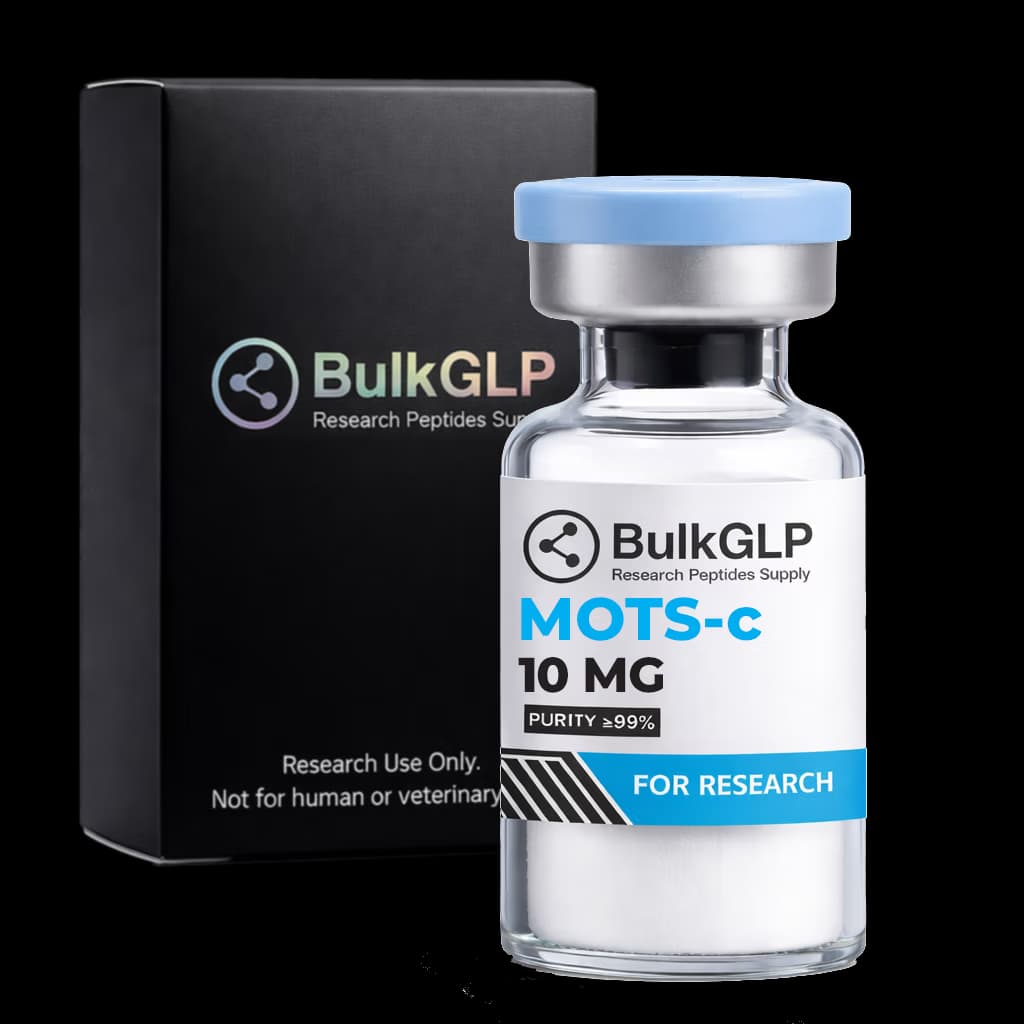
MOTS-c Peptide – Research Vial 10 mg, 20 mg, 40 mg
MOTS-c is offered as a lyophilized research peptide in 10 mg, 20 mg and 40 mg vial options, with mannitol listed as a stabilizer. Select the size and review the documentation for the corresponding material and lot. For in-vitro or ex-vivo laboratory research only; not for human or veterinary use.
View batch documentationAbout MOTS-c
MOTS-c is a mitochondrial-derived peptide of 16 amino acids. Its name points to where it is encoded: a short open reading frame inside the mitochondrial gene for 12S ribosomal RNA. The reference form is a linear chain with free terminal amine and acid groups and the sequence MRWQEMGYIFYPRKLR.
BulkGLP lists three lyophilized vial sizes, 10 mg, 20 mg and 40 mg, each with mannitol listed as a stabilizer. The sizes hold the same peptide in different nominal amounts, and every size is offered singly or as a 10-pack at 20% off per vial. The COA published on this page covers the current 20 mg lot.
- Format
- Lyophilized vials
- Sizes
- 10, 20 and 40 mg
- Order options
- Single or 10-pack · the 10-pack saves 20% per unit
- Latest lot report
- 99.41% reported purity · Lot 5105
- Ships
- Same business day when paid before 2 PM Central · USPS, UPS or FedEx with tracking
- Storage
- Sealed and dry, typically −20 °C · Storage guide
Research context and material documentation
Separate molecular identity and published research from the format supplied here and the results reported for an individual lot.
MOTS-c identity and amino acid sequence
MOTS-c is a sixteen-residue peptide whose name refers to a mitochondrial open reading frame associated with 12S ribosomal RNA. The published human sequence is MRWQEMGYIFYPRKLR. Written with explicit terminal groups, the reference is H-Met-Arg-Trp-Gln-Glu-Met-Gly-Tyr-Ile-Phe-Tyr-Pro-Arg-Lys-Leu-Arg-OH. These identity details distinguish the unmodified reference peptide from an acetylated derivative, altered sequence or other mitochondrial-derived peptide.
PubChem provides the parent formula and average molecular weight below. Counterions, residual water and formulation ingredients are outside that molecular definition. A salt name appearing among database synonyms should not be treated as proof of the form supplied in a particular product. Establish the product's chemical form from the specification and lot documentation.
Mitochondrial and nuclear research context
Lee and colleagues' discovery paper investigated MOTS-c in cell systems and mice, linking the proposed short open reading frame to experiments on cellular metabolism. Kim and colleagues subsequently examined nuclear localization during metabolic stress. Their work used subcellular fractionation and immunofluorescence, alongside studies of nuclear gene regulation. These papers explain why MOTS-c appears in research on communication between cellular compartments.
The reported observations depend on the biological model, stress condition, detection method and comparison group. A localization measurement and a change in a metabolic endpoint answer different experimental questions. They do not demonstrate a predictable effect from a commercial vial, establish a human benefit or validate an unrelated preparation. Use the original methods when assessing whether a paper is relevant to a proposed laboratory question.
Sequence-sensitive analytical assessment
The reference contains two methionine residues and several aromatic residues, making chemical modification and detection method relevant subjects for analytical evaluation. That is a reason to inspect the actual chromatogram and mass data, not a claim about the rate of change or stability of this lot. A reported extra peak requires identification before it can be assigned to a particular modification.
LC-MS identity assessment should show the expected species, observed charge states and mass comparison. Sequence fragments can provide information beyond an intact mass alone. Separately review chromatographic purity and quantitative content. A matching parent ion does not determine the total peptide amount, and a percentage based on detected chromatographic peaks is not automatically a mass fraction of all material in the vial.
Document any disagreement between a reference value and the laboratory result before using that result in a comparison. Average molecular weight, monoisotopic mass and observed mass-to-charge ratio are different quantities; apparent numerical differences can reflect reporting conventions rather than a different peptide.
Vial sizes, formulation and handling history
The catalog offers nominal 10 mg, 20 mg and 40 mg research-vial selections. Those quantities are product-format labels, not different MOTS-c molecular identities. Check the selected size and formulation against the report rather than extending one submitted sample's result to every available option.
Retain the lot number, receipt condition, documented storage requirements and analytical sample history. Record whether reported quantities describe peptide, salt or total preparation. Preparation conditions and retest decisions belong to the laboratory's method and the material's supporting evidence. No universal expiry, solution stability or formulation composition is assigned by this reference.
Frequently asked questions
Does a larger nominal vial contain a different sequence?
No. The listed fill sizes concern packaging quantity. Molecular identity still depends on the same specified sequence, terminal groups and chemical form.
Can literature about a modified MOTS-c analogue be used as its specification?
No. An analogue with a different sequence or terminal modification requires its own identity description. Match each paper and analytical comparison to the exact compound.
Related research materials
Molecular reference specifications
Reference identities do not establish a supplied lot’s analytical results.
- Reference compound
- MOTS-c; human reference sequence; linear 16-residue peptide
- Parent CAS registry number
- 1627580-64-6
- Parent molecular formula
- C101H152N28O22S2
- Parent molecular weight
- 2174.6 g/mol (PubChem average molecular weight)
- Reference sequence
- H-MRWQEMGYIFYPRKLR-OH
- Supplied salt, water and formulation
- Not established by the parent identifiers; check the selected product and lot
Sources: PubChem: MOTS-c, CID 146675088 (opens in a new tab) · Lee et al.: discovery and experimental characterization of MOTS-c (2015) (opens in a new tab) · Kim et al.: stress-associated nuclear translocation of MOTS-c (2018) (opens in a new tab) · USP researchers: reference standards and quality characterization of synthetic peptides (2023) (opens in a new tab)
Editorial review: · BulkGLP.
THE BULKGLP STANDARD
Quality tested.
Confidence delivered.
Our quality program combines independent lab testing for purity, identity and content with published batch reports. See the results behind BulkGLP quality and shop with confidence.
For the limits of a report and the distinction between identity, purity and content, read public analytical verification.
CONTINUE EXPLORING
Related research products.
 In stock
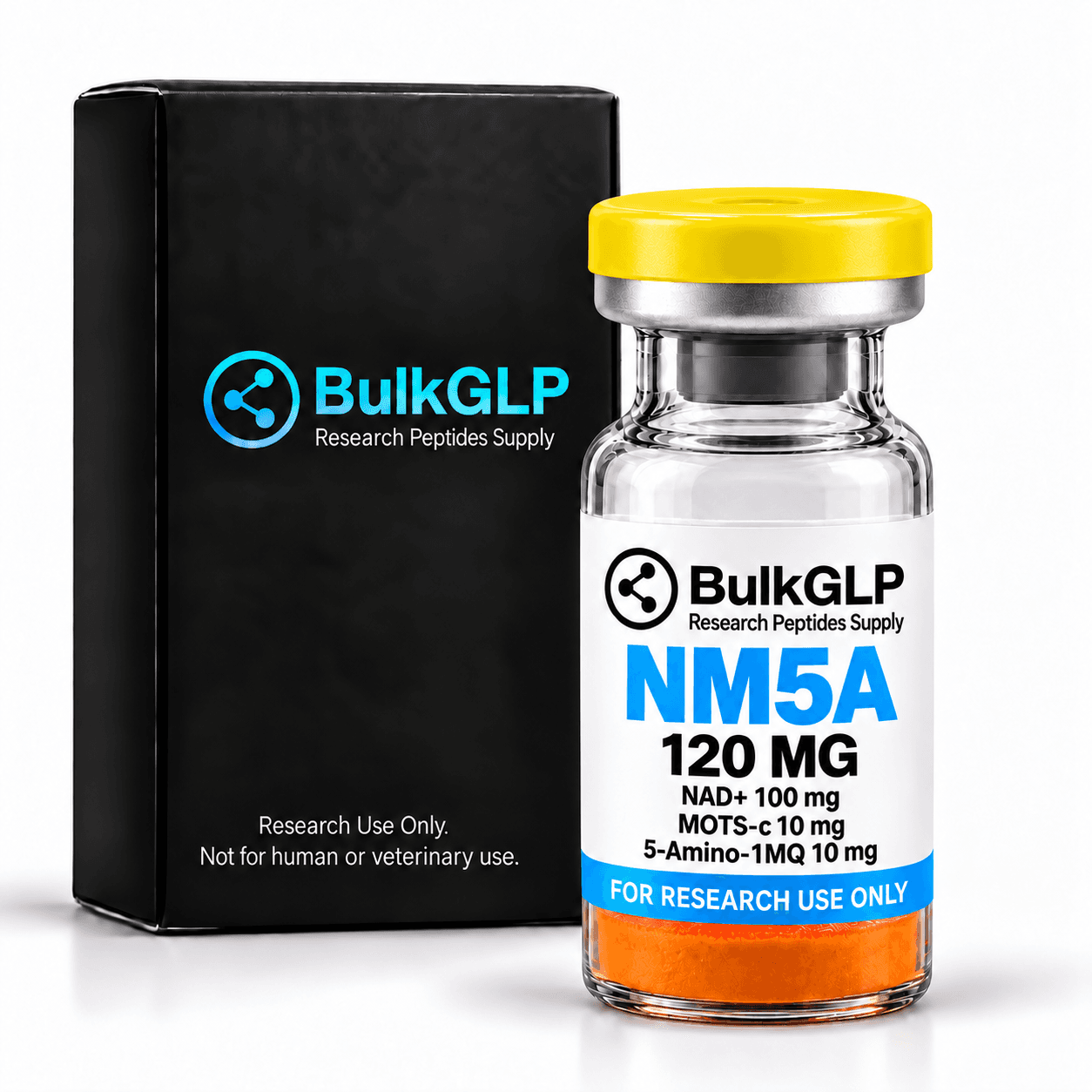
NAD+ / MOTS-c / 5-Amino-1MQ Blend — 120mg (NM5A)
120mg
 In stock
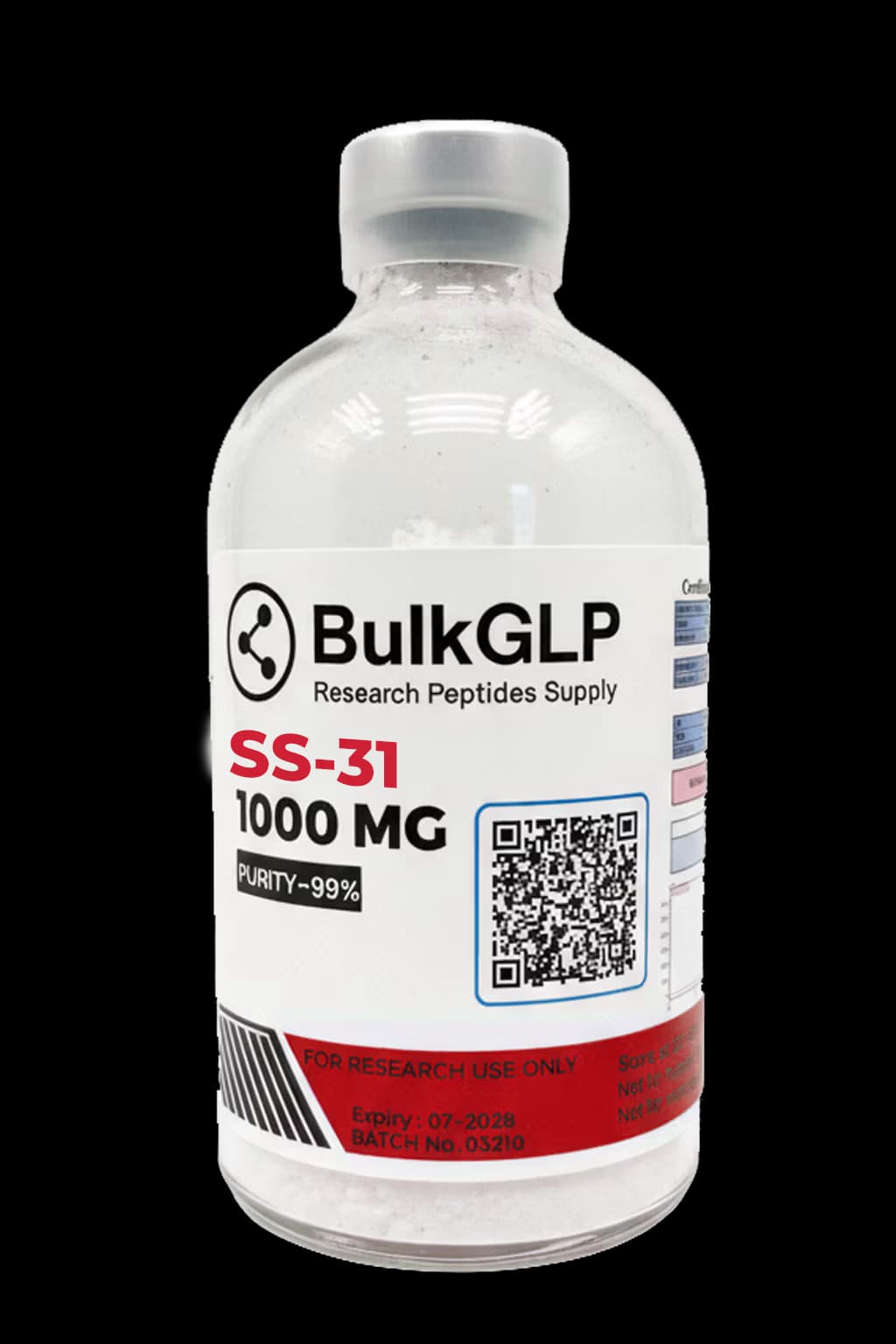
SS-31 Research Powder — 1000mg (1g)
 In stock
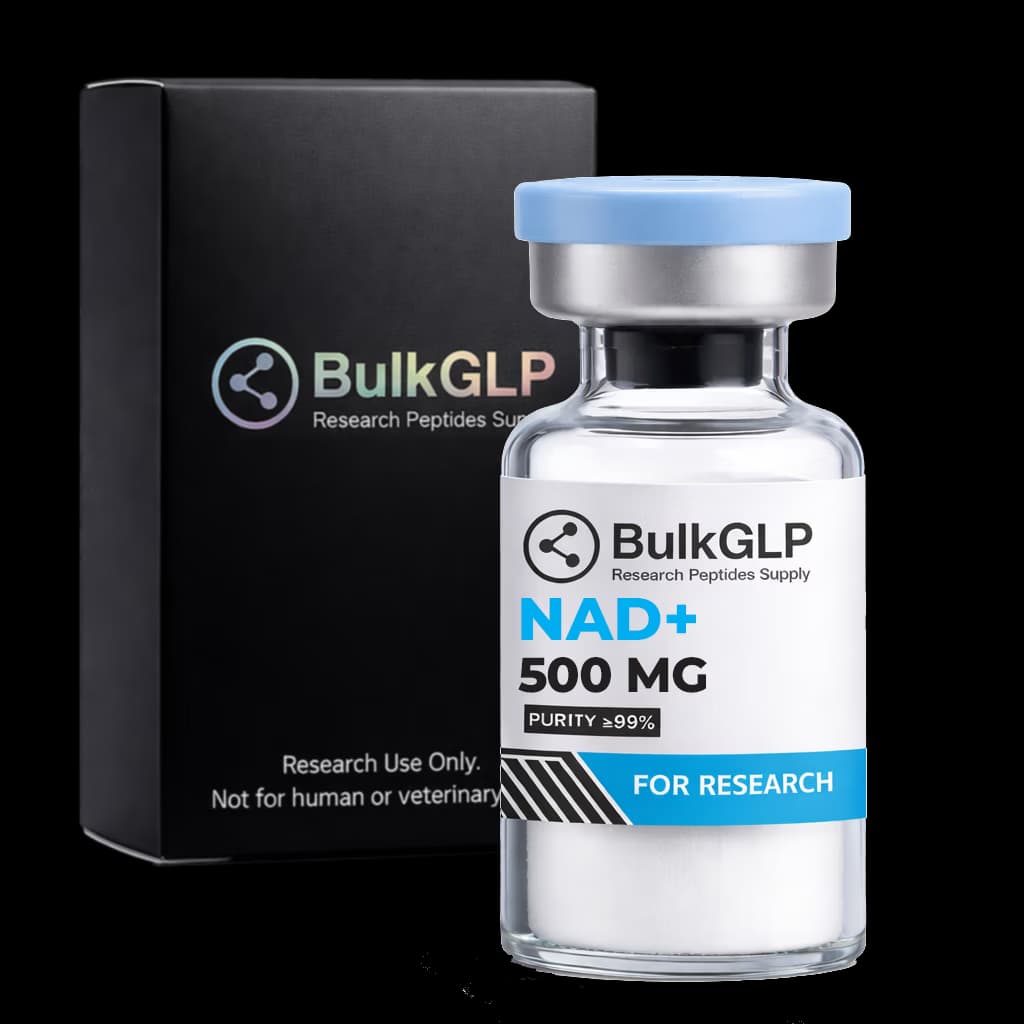
NAD+
2 format options
 In stock
Tesamorelin 10mg
2 format options