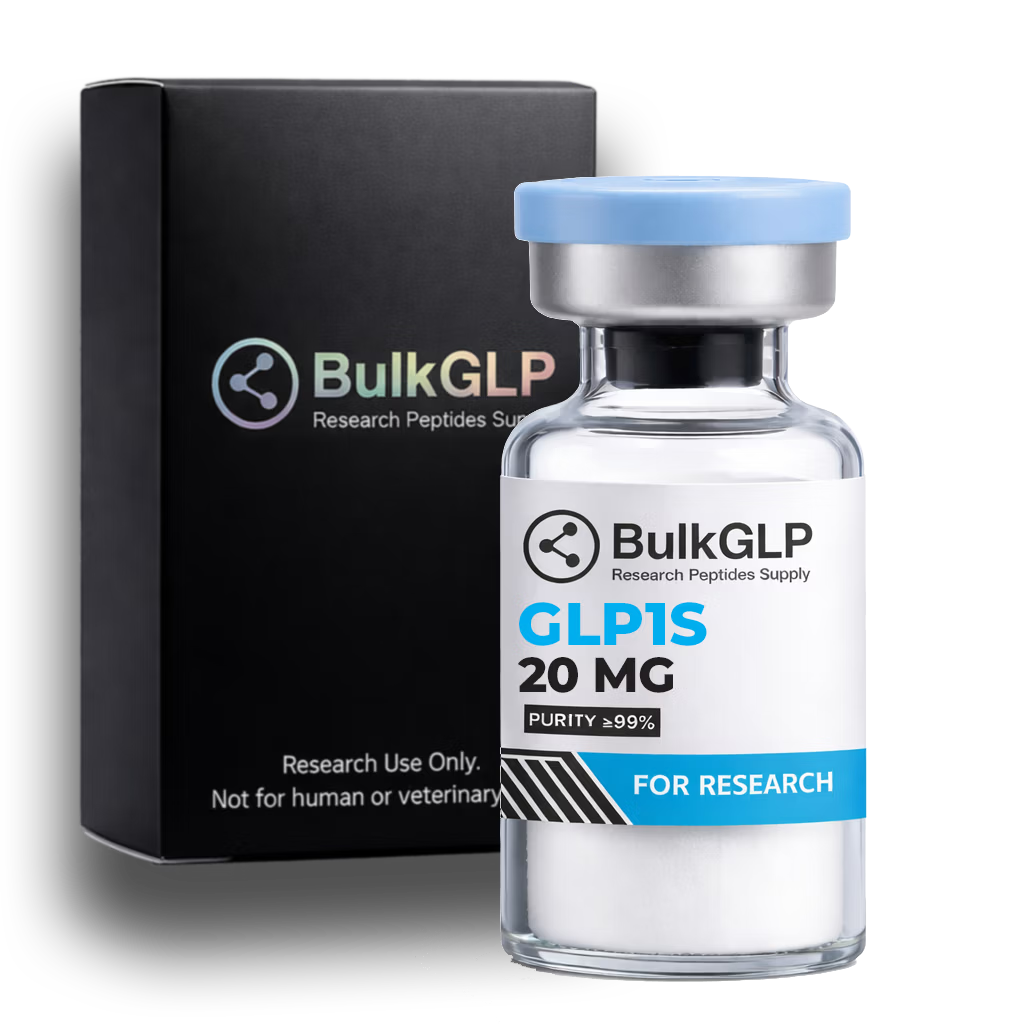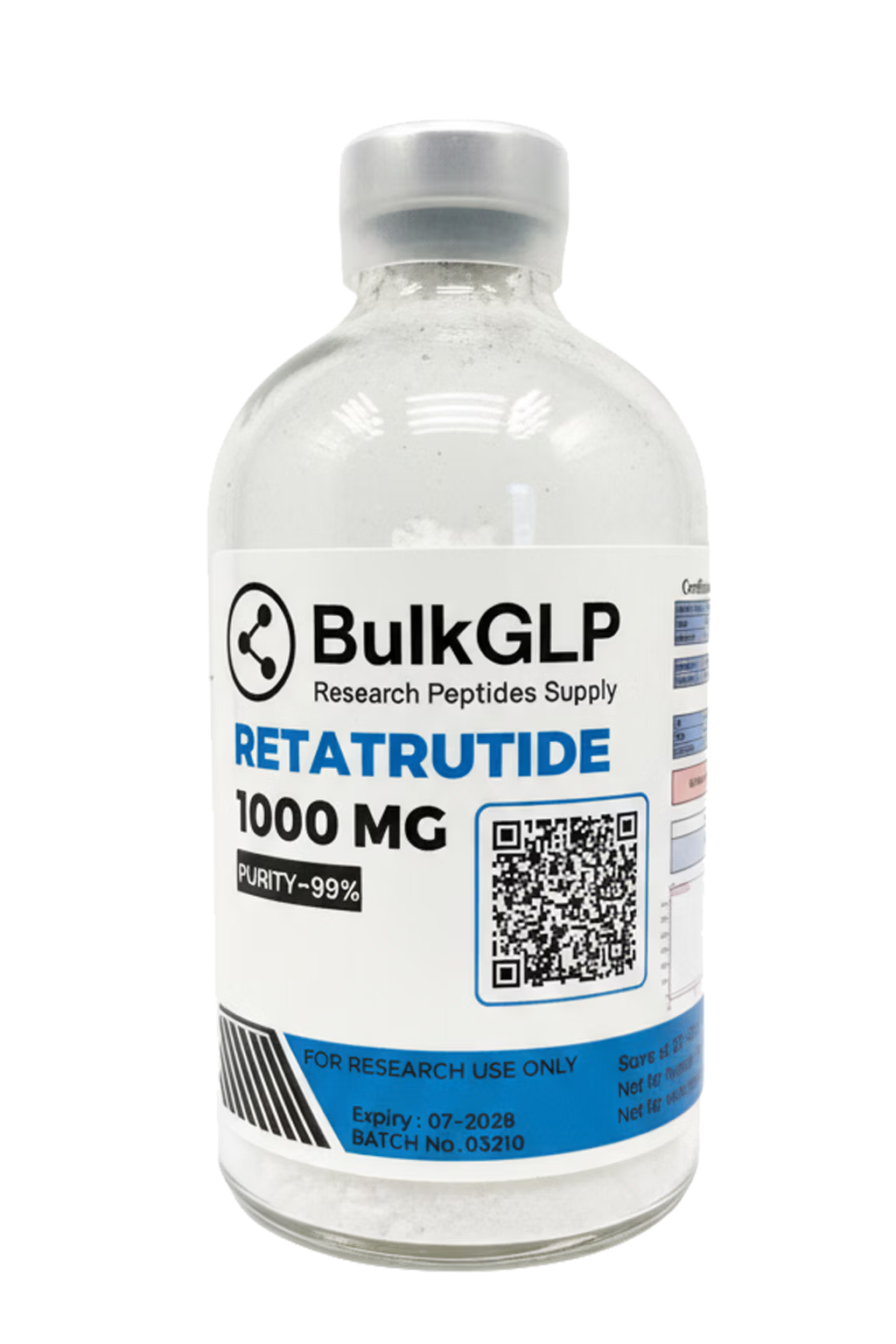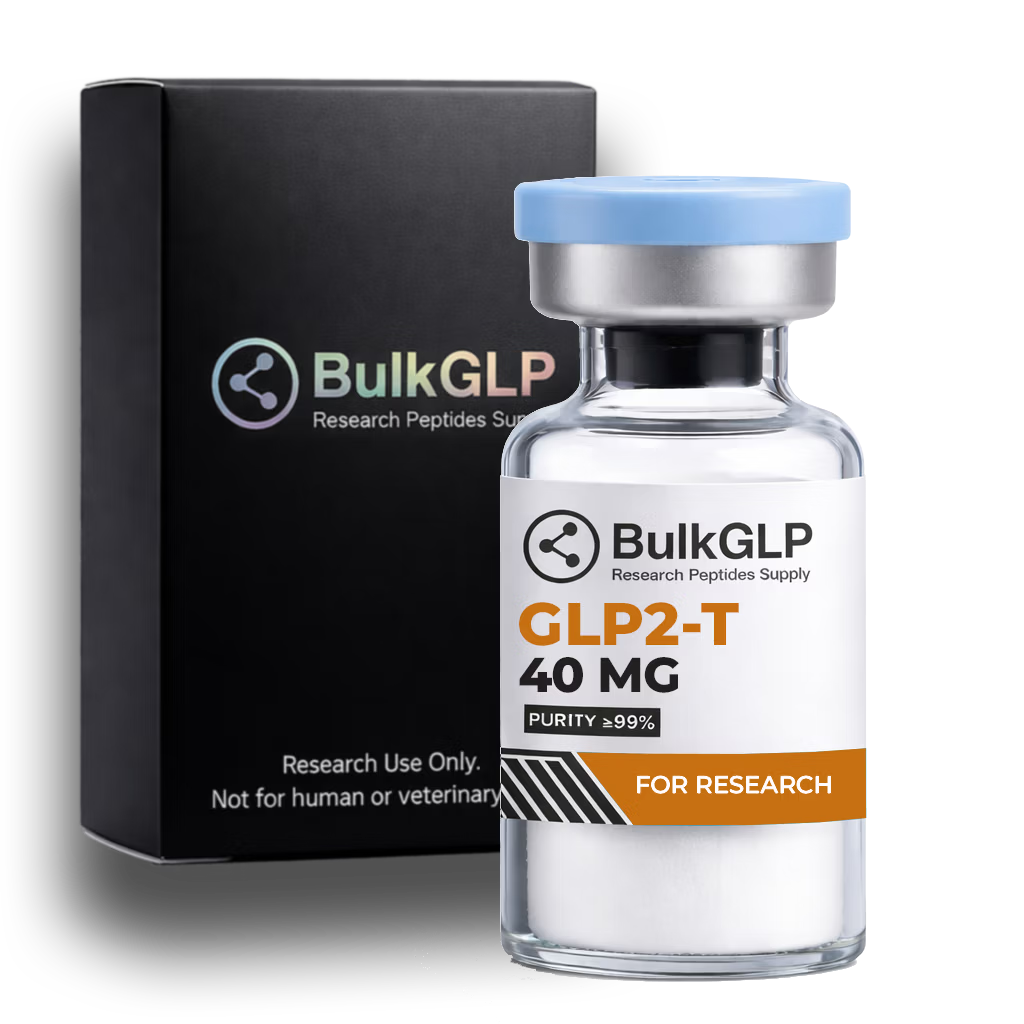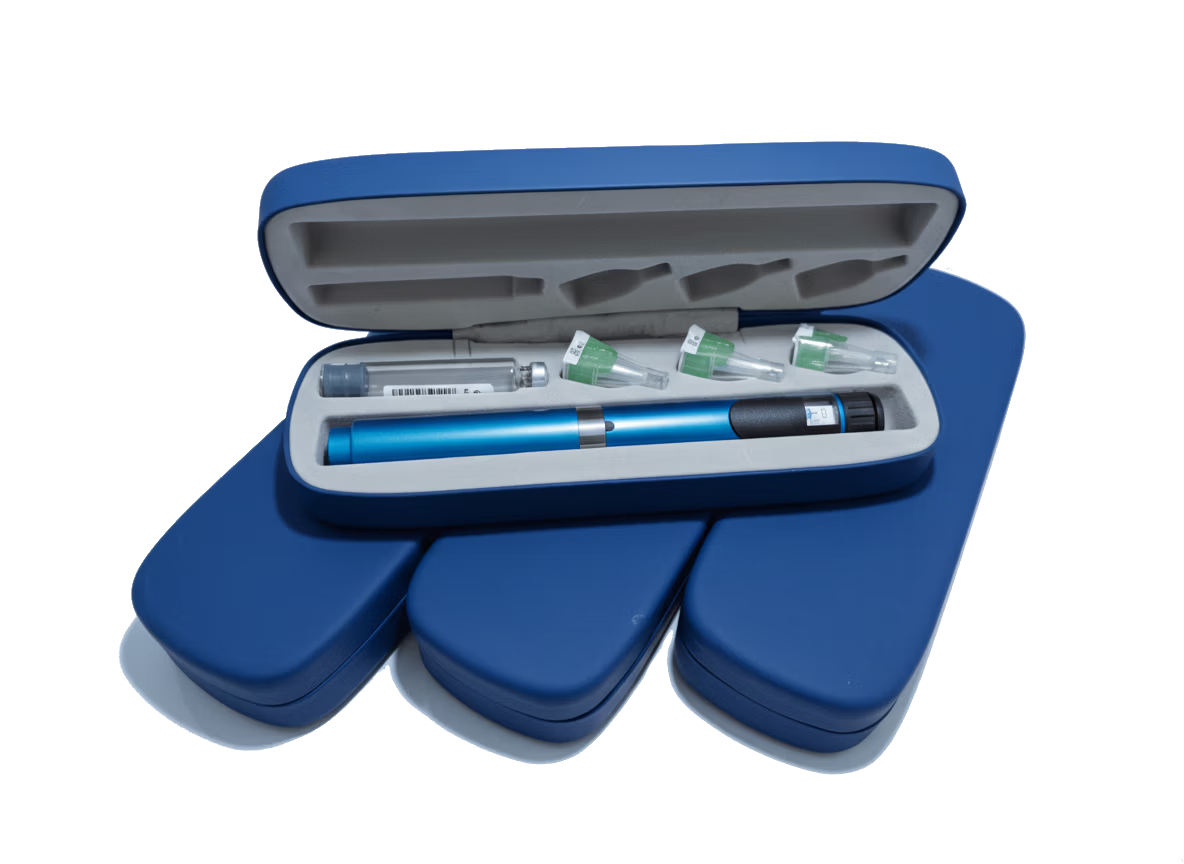
Retatrutide — Research Peptide for Sale
Free Priority Shipping on Orders $99+
Retatrutide (LY3437943) research vials for qualified laboratory use. Select a currently available vial size and formulation. The selected variation label and matching lot documents control formulation, measured content, purity, and reported tests. A Standard vial must not be assumed to be Mannitol-Free. Not for human or veterinary use.
From $120.00
Lab reports & batch history 6 current · 10 prior reports View lab reportsClose
View laboratory methods and results in each report.
Prior batch reports (10)
Buy With Confidence
Check the lot, review the results and see our report history—all before you order. Our team is here for product details, shipping and order support.
Retatrutide peptide for sale at BulkGLP is supplied as lyophilized research material in single-vial and ten-pack configurations. Retatrutide, also identified as LY3437943, is studied for activity at GLP-1, GIP, and glucagon receptors. Choose the exact vial size and formulation in the product selector above, then review the current price, availability, and matching lot report before placing a laboratory order. This page brings the catalog options, analytical documents, research identifiers, and receipt checklist together. For purchasing comparisons, read the retatrutide cost guide.
BulkGLP offers Standard and Mannitol Free selections. These are distinct catalog choices: the name of the parent product does not establish the formulation of every vial. The variation selected, its label, and its applicable lot documents identify the material being ordered. Materials are for in-vitro laboratory research and development only. Not for human or veterinary use.
Synonyms, Chemical Nomenclature & Research Identifiers
- Primary compound name
- Retatrutide peptide
- Research identifier
- LY3437943
- Alternate catalog and search terms
- GLP-3 peptide, GLP3, GLP3 Retatrutide, and GLP3Retatrutide
- Colloquial abbreviations
- Reta and Reta peptide
- Research classification
- Triple agonist investigated at the glucagon-like peptide-1 receptor (GLP-1R), glucose-dependent insulinotropic polypeptide receptor (GIPR), and glucagon receptor (GCGR)
- CAS registry identifier
- 2381089-83-2
- Reference molecular formula
- C221H342N46O68
- Approximate reference molar mass
- 4731.33 g/mol, or approximately 4.73 kDa
Use the compound name and LY3437943 identifier together when matching a publication, a purchase record, and an analytical report. Short names such as Reta can help locate a catalog listing, but they are not sufficient identifiers for a laboratory sample. Likewise, GLP-3 is a commonly used catalog label for the triple-agonist research context; the receptor names above are the more precise description of the studied targets.
The reference formula and molar mass describe a chemical reference structure. They do not state how many milligrams are in a particular vial or identify the complete composition of every offered formulation. A vial labeled 10 mg describes a nominal material amount; a molecular mass expressed in g/mol describes a different property. Consult the PubChem structure record and the Retatrutide substance record alongside the lot-specific laboratory evidence. PubChem rounds the reference molecular weight to 4731 g/mol.
Retatrutide vial sizes, packs, and current prices
The catalog contains Standard single vials labeled 10 mg, 12 mg, 15 mg, 20 mg, 30 mg, and 50 mg. Standard ten-packs contain ten vials of the selected 10 mg, 15 mg, 20 mg, or 30 mg size. Mannitol Free single-vial selections are listed at 10 mg, 15 mg, 20 mg, and 30 mg. Availability belongs to each individual variation; a listed configuration may be temporarily out of stock.
For a ten-pack, the amount in the size label is the nominal amount per vial. A 10 mg ten-pack therefore represents ten 10 mg vials and a nominal total of 100 mg. A ten-pack is one catalog configuration, so its listed product price applies to that pack. A single-vial selection represents one vial. Confirm the complete selection and order quantity in the cart before purchasing.
| Configuration | Formulation | Vials | Nominal total | Price | Price per vial | Price per mg | Availability |
|---|---|---|---|---|---|---|---|
| 10mg | Standard (Default) | 1 | 10 mg | $120.00 | $120.00 | $12.00 | In stock |
| 12mg | Standard (Default) | 1 | 12 mg | $133.00 | $133.00 | $11.08 | In stock |
| 15mg | Standard (Default) | 1 | 15 mg | $149.00 | $149.00 | $9.93 | In stock |
| 20mg | Standard (Default) | 1 | 20 mg | $189.00 | $189.00 | $9.45 | In stock |
| 30mg | Standard (Default) | 1 | 30 mg | $228.00 | $228.00 | $7.60 | In stock |
| 50mg | Standard (Default) | 1 | 50 mg | $346.00 | $346.00 | $6.92 | In stock |
| 10mg - 10 Pack | Standard (Default) | 10 | 100 mg | $949.00 | $94.90 | $9.49 | In stock |
| 15mg - 10 Pack | Standard (Default) | 10 | 150 mg | $1,193.00 | $119.30 | $7.95 | In stock |
| 20mg - 10 Pack | Standard (Default) | 10 | 200 mg | $1,369.00 | $136.90 | $6.85 | In stock |
| 30mg - 10 Pack | Standard (Default) | 10 | 300 mg | $1,799.00 | $179.90 | $6.00 | In stock |
| 10mg | Mannitol Free | 1 | 10 mg | $153.00 | $153.00 | $15.30 | In stock |
| 15mg | Mannitol Free | 1 | 15 mg | $193.00 | $193.00 | $12.87 | Out of stock |
| 20mg | Mannitol Free | 1 | 20 mg | $232.00 | $232.00 | $11.60 | Out of stock |
| 30mg | Mannitol Free | 1 | 30 mg | $281.00 | $281.00 | $9.37 | Out of stock |
Prices use the store currency and shop tax-display setting. Unit prices use nominal labeled amounts and are rounded; shipping and other applicable checkout charges are separate. Confirm the selected variation and checkout for the current offer. Read the matching lot report for analytical results.
Compare retatrutide cost by vial, pack, and nominal milligram. For quantities or documentation requirements outside the listed selections, use the wholesale peptides and bulk order inquiry.
The price table reports the catalog offer for each configuration. It does not reserve stock, create an additional size, or establish a custom pack. The current product selector and checkout determine what can be purchased. Standard and Mannitol Free entries should be compared separately because a price comparison does not establish that their composition is interchangeable for a particular analytical method.
How to compare price per vial and price per milligram
A useful laboratory purchasing comparison keeps three quantities separate: the price of the selected configuration, the number of vials included, and the nominal total material amount. Price per vial equals the configuration price divided by the vial count. Price per nominal milligram equals the configuration price divided by the nominal amount per vial multiplied by the vial count. These figures allow single-vial and multipack offers to be compared on the same basis.
For example, ten vials labeled 20 mg represent 200 mg nominal total. The relevant denominator for the pack’s price per milligram is 200 mg, while the denominator for its price per vial is ten. The table performs this arithmetic using the published configuration and current catalog price. Displayed values are rounded for readability; keep the unrounded arithmetic in an internal procurement worksheet if comparing several offers.
Nominal-price comparisons do not substitute a tested sample’s measured content into every vial in a pack. The quantity measured in a submitted sample belongs to its report. For budgeting, use the labeled configuration consistently, then assess analytical suitability from the documentation. Shipping charges, any applicable checkout charges, and a separately arranged bulk quotation can change the final order total.
A laboratory can also compare the number of independently sealed vials it needs, the quantity its approved project expects to consume, and its validated storage window. A lower nominal price per milligram is only one part of that decision. Keep the exact formulation, lot requirement, report reference, and intended assay method in the purchase specification so that a later reorder can be assessed against the same requirements.
Lot-specific COAs and analytical reports
The lab-report panel on this product page includes current and prior batch records. Start with the lot printed on the vial, then compare the compound, labeled size, and report identity. A report for another size or lot is useful historical documentation, but it is not automatically the report for the material in your order. If the formulation is not clearly identified in the available documents, contact BulkGLP for clarification before treating that report as a formulation-specific match.
| Labeled sample | Lot | Reported content | Reported purity | Identity information | Report |
|---|---|---|---|---|---|
| 10 mg | 062503 | 11.20 mg | 99.87% | LC-MS identity confirmed | 2606190261, PDF |
| 12 mg | 062503 | 13.75 mg | 99.50% | Identity confirmed in report summary | 2605210278, PDF |
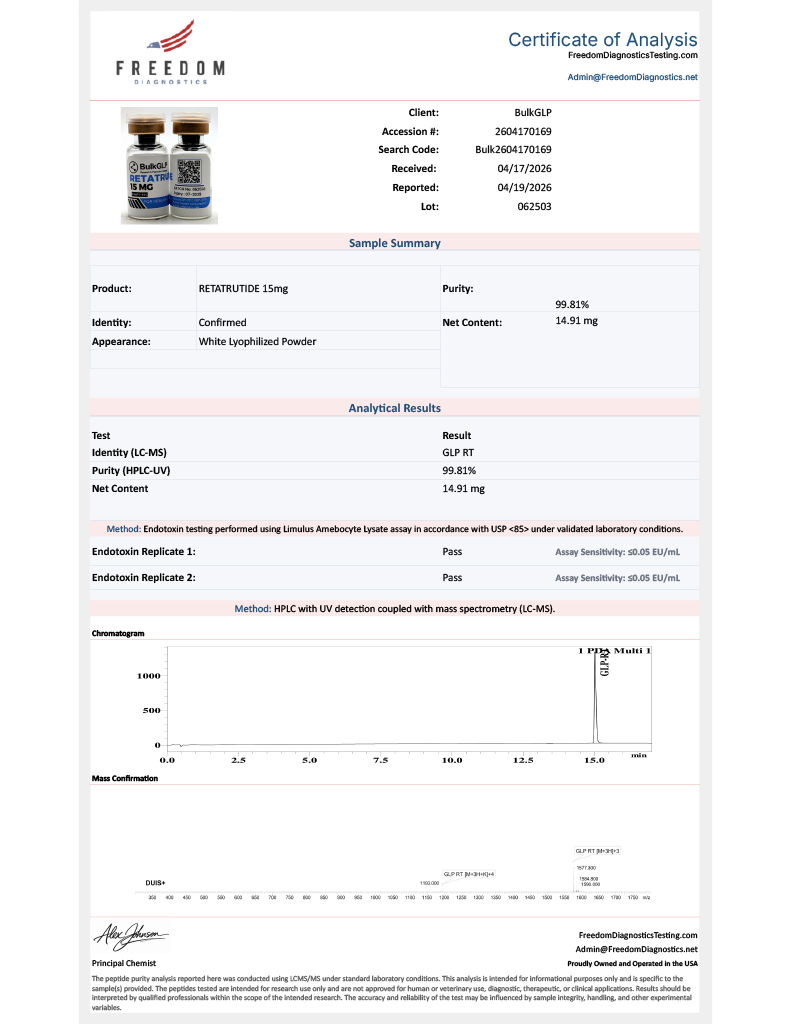
| 15 mg | 062503 | 14.91 mg | 99.81% | Review original report | 2604170169, image |
| 20 mg | 062503 | 22.69 mg | 99.81% | LC-MS identity confirmed | 2605210279, PDF |
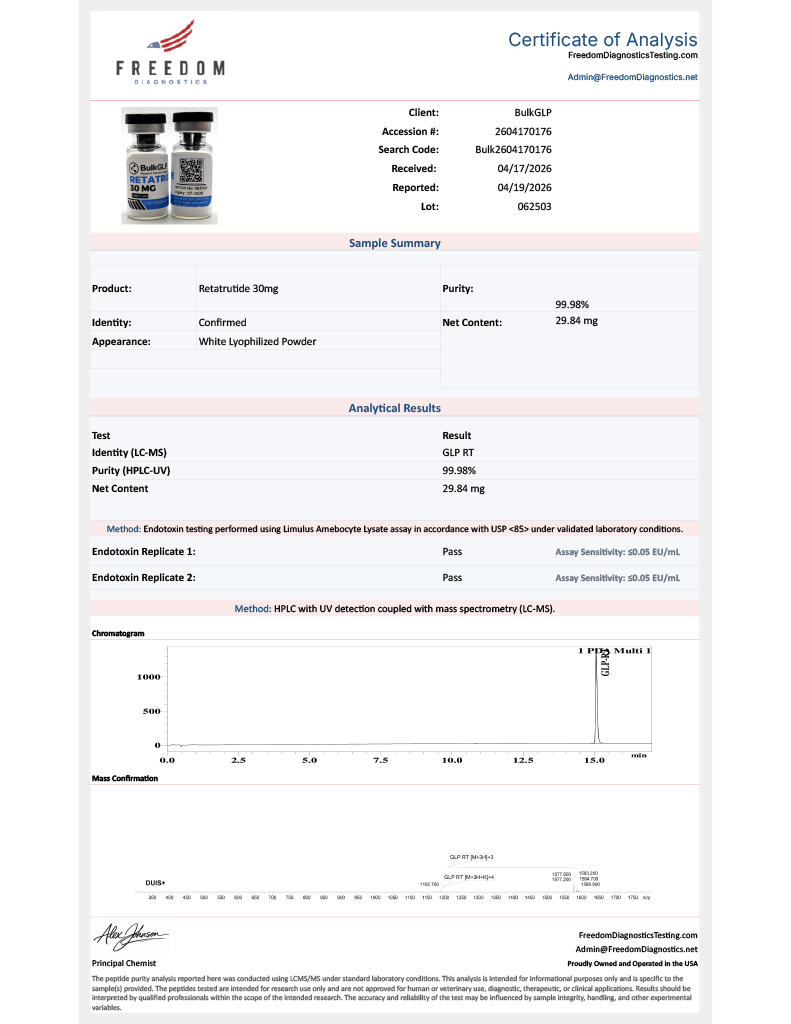
| 30 mg | 062503 | 29.84 mg | 99.98% | Review original report | 2604170176, image |
| 50 mg | 062504 | 54.13 mg | 99.87% | Identity confirmed in report summary | 2608100929, PDF |
Open the batch-report archive for the complete documents and prior records. These results apply to the identified submitted samples. Check the product-page report panel for subsequent records and confirm the relevant lot before ordering.
Purity, identity, and measured content answer different questions. The referenced PDF reports distinguish HPLC-UV purity from LC-MS identity and net content. A purity percentage is not a measurement of the vial’s total powder mass. Conversely, a measured content figure does not independently establish the chemical identity of the material. Read the reported method and the actual result together instead of treating a single percentage as a complete quality specification.
Some reports also contain endotoxin, microbial, or other screening results. Only attribute a result to the sample and method explicitly named in that document. A report that does not list a particular test does not establish that the test was performed. The report number, lot, sample description, and reporting date provide a traceable record; retain the original document with your laboratory receipt record.
Before ordering, define the evidence your project needs. That may include a match between the sample name and label, a specific analytical identity result, a documented content measurement, or a report for a particular lot. If a required detail is absent, ask for it rather than substituting a report for a different option. The guide to reading a peptide COA explains the separate fields, while the where to get retatrutide guide organizes the purchasing checks.
Scientific background: a triple receptor agonist
Retatrutide is a single synthetic peptide investigated at GCGR, GIPR, and GLP-1R. The discovery paper by Coskun and colleagues describes LY3437943 and reports receptor-based laboratory characterization and preclinical metabolic studies. Its triple-agonist designation refers to activity across those three receptor systems. It does not mean the material is a mixture of three separately supplied peptides. See the original LY3437943 discovery study.
For laboratory interpretation, receptor binding and functional receptor activation are different measurements. A binding experiment examines an interaction with a receptor; a functional assay examines a subsequent response under specified conditions. The paper’s cell-based signaling work and preclinical findings provide a research context, but they do not certify the performance of a separately supplied commercial sample. Use the original methods when deciding whether an assay is relevant to your project.
Document the receptor model, assay conditions, reference material, and endpoint when comparing experimental results. A number obtained in one system should not be treated as a universal specification for another system. The Retatrutide research guide provides the supporting scientific overview. Product selection should still be based on the precise material identity and the laboratory’s own acceptance criteria.
Retatrutide, Tirzepatide, and Semaglutide
These names identify different peptide compounds with different research receptor profiles. Retatrutide is studied as a GLP-1R/GIPR/GCGR triple agonist. Tirzepatide is studied as a GIPR/GLP-1R dual agonist, as described in the LY3298176 discovery paper. Semaglutide is a GLP-1 analogue with GLP-1 receptor activity; its molecular design is described in the original Semaglutide discovery publication.
A shared research topic does not make these compounds interchangeable. Different names, chemical structures, and receptor profiles require distinct sample records and assay plans. For a comparison experiment, specify each material independently and record its supplier, formulation, lot, labeled amount, and documentation. Apply the same reporting conventions when comparing analytical results so that a difference in recordkeeping is not mistaken for a difference in experimental performance.
Related catalog pages are available for Tirzepatide research peptide and Semaglutide research peptide. For the nomenclature question, read is Tirzepatide a peptide? Each product’s own variation selector and lot documents control its supplied configuration.
Laboratory receipt, storage, and handling
Start the receipt process before a vial is opened. Record the shipment date, arrival date, package condition, selected configuration, vial count, label details, and lot. Compare those details with the order confirmation and the relevant report. Save any required package photographs and assign the received material an internal sample identifier. This connects the purchase record to subsequent preparation and analytical work.
Use the storage instructions applicable to the received material and the laboratory’s validated procedure. A general temperature recommendation cannot establish the stability of every formulation, container, or prepared solution. If the documents supplied with a lot do not state a condition your project requires, request clarification before setting the storage specification. The site’s peptide storage guide is supporting guidance, not a replacement for lot-specific documentation.
For any controlled-temperature procedure, record the assigned storage location and the relevant monitoring record. If the laboratory uses frozen storage, its procedure should define the permitted temperature range, transfer conditions, and handling of temperature excursions. Track removal and return when required by that procedure. A freezer setpoint alone does not establish how long a prepared sample remains suitable for a particular assay.
Keep the container identified throughout handling and follow the procedure’s requirements for light exposure, moisture, mixing, and repeated temperature changes. Inspect and document visible changes without treating appearance as an identity or purity test. If a sample exceeds an established handling limit, assess it using the laboratory’s acceptance process before including it in a study. Do not infer a fixed shelf life from the presence of an unopened vial.
After preparation, the original lot identifier remains relevant, but the prepared solution needs its own record. Document the preparation date, solvent, final volume, calculated concentration, container, operator, and assigned use window. Keep dry-material records separate from prepared-solution records. This makes it possible to reconstruct what was tested and to distinguish a supplier lot from a laboratory preparation made from that lot.
Solvent selection and concentration calculations
Choose the solvent through the laboratory method rather than the product’s nickname or nominal vial size. A suitable procedure defines compatibility with the material and with the downstream analytical system. Solvent composition, final volume, and any subsequent dilution belong in the method record. The presence of an accessory in the catalog does not establish that it is appropriate for every research assay.
BulkGLP’s reconstitution solution is the existing bacteriostatic-water accessory containing 0.9% benzyl alcohol, offered as one box of two 10 mL vials. Review that product’s specifications and your laboratory’s solvent requirements before selecting it. The research protocol must account for the actual solution composition; a preservative-containing solution should not be treated as an unspecified blank.
For a basic mass-concentration check, divide the documented material mass in milligrams by the final solution volume in milliliters. The result is milligrams per milliliter. For example, a hypothetical analytical preparation with 10 mg documented material in a final volume of 2 mL has a nominal concentration of 5 mg/mL. This arithmetic example does not select a solvent, validate recovery, or establish an assay procedure.
Use the peptide reconstitution calculator to check the calculation, then retain the inputs and result in the preparation record. Specify whether the calculation uses nominal labeled material or a documented analytical quantity. Use the same basis throughout a worksheet, and have the calculation checked under the laboratory’s normal review process.
U.S. shipping, tracking, and order planning
Under BulkGLP’s published shipping policy, orders with payment received and cleared before 2 PM Central Time on a business day ship that same business day. Orders paid at or after the cutoff, on weekends, or on U.S. holidays ship the next business day. Payment, address, or inventory verification can delay dispatch. The cutoff follows local Dallas time.
Available carriers and service levels appear at checkout. Rates depend on package weight, destination, and selected speed. Tracking is emailed when the order ships. The published domestic transit estimates are typically three to five business days for Standard, two to three business days for Expedited, and one business day for Overnight where supported. Transit estimates and processing time are separate parts of the schedule.
If a research project requires a specified arrival window or particular transport conditions, confirm those requirements with support before ordering. The shipping policy does not establish a product-specific temperature guarantee. Provide a complete receiving address and arrange for the laboratory to inspect and record the shipment promptly. Keep the carrier tracking record with the order documentation.
Ordering and documentation support
A complete purchasing specification identifies the compound, nominal vial size, formulation, number of vials, and required lot documents. For a repeat order, compare the new selection against that specification even when the parent product name is unchanged. Stock and lot assignments can change between purchases. Save the confirmation and the report used for the review so that the original basis for acceptance remains accessible.
For an unlisted quantity, a same-lot requirement, or a documentation question, contact support@bulkglp.com or use the bulk order inquiry. Include the exact product option and the report number if your question concerns a particular document. This gives support a specific configuration to check and reduces ambiguity between nominal size, total pack amount, and tested sample content.
Retatrutide purchasing FAQ
Is Retatrutide peptide available for sale at BulkGLP?
Yes. BulkGLP lists Retatrutide research vials in Standard and Mannitol Free configurations. Availability is specific to the selected variation, so check its current stock and price above before ordering. Select the required size, formulation, and quantity, then review the matching lot documents. Materials are for in-vitro laboratory research and development only, not for human or veterinary use.
Where can researchers buy authentic Retatrutide online with verified COAs?
Researchers can review BulkGLP’s available Retatrutide options on this page and open the linked analytical reports before purchasing. Verification should connect the received vial’s label, size, formulation, and lot to the applicable document. Read the original report for its sample identity and methods. If a required detail is missing or the lot does not match, request clarification from support before accepting the material.
How much does Retatrutide cost?
The current price depends on the selected size, formulation, and single-vial or ten-pack configuration. The table above reads the current catalog offers and shows the price per configuration, per vial, and per nominal milligram where the pack amount is established. The selected variation and checkout control the offer. See the retatrutide cost guide for purchasing comparisons.
What sizes and configurations are available?
The catalog lists Standard single vials at 10, 12, 15, 20, 30, and 50 mg; Standard ten-packs at 10, 15, 20, and 30 mg per vial; and Mannitol Free single vials at 10, 15, 20, and 30 mg. Listed configurations can be out of stock. Check the selector and live table for the current offer, and confirm whether the selection is a single vial or ten-pack.
Where is the COA for this specific lot and what does it show?
Use the lab-report panel and report links on this page, then match the document to the lot and labeled size on the vial. Reports identify the submitted sample and its recorded results, which can include HPLC purity, LC-MS identity, and measured content. Additional tests vary by report. Do not substitute another lot’s document or assume a report establishes details it does not contain.
How should Retatrutide be stored and handled upon laboratory receipt?
Record the package condition, vial count, label, lot, and receipt date, then apply the storage and handling conditions documented for the received material and your laboratory’s validated procedure. Keep the lot record with any preparation record. Confirm unspecified temperature, solvent, light-exposure, or stability requirements before use. Prepared solutions need their own labeled concentration, preparation date, and validated handling window.
How is Retatrutide shipped within the USA, and how quickly?
The published policy provides same-business-day shipping when payment is received and cleared before 2 PM Central on a business day. Later payments, weekends, and U.S. holidays move dispatch to the next business day; verification can delay it. Standard domestic transit is typically three to five business days. Checkout shows available services and rates, and tracking is emailed when the order ships.
What is the chemical difference between Retatrutide, Tirzepatide, and Semaglutide?
They are distinct peptide compounds. Retatrutide is studied at GLP-1, GIP, and glucagon receptors; Tirzepatide at GIP and GLP-1 receptors; and Semaglutide at GLP-1 receptors. Their molecular designs and research receptor profiles differ. They should have separate sample specifications, lot records, and assay plans rather than being treated as interchangeable materials.
For in-vitro laboratory research and development use only. Not for human or veterinary use.
| Weight | 0.1 lbs |
|---|---|
| Dimensions | 2 × 2 × 2 in |
| Size | 5mg, 10mg, 12mg, 15mg, 20mg, 30mg, 50mg, 5mg – 10 Pack, 10mg – 10 Pack, 15mg – 10 Pack, 20mg – 10 Pack, 30mg – 10 Pack |
| Formulation | Standard (Default), Mannitol Free |