
Bulk Raw Research Powders
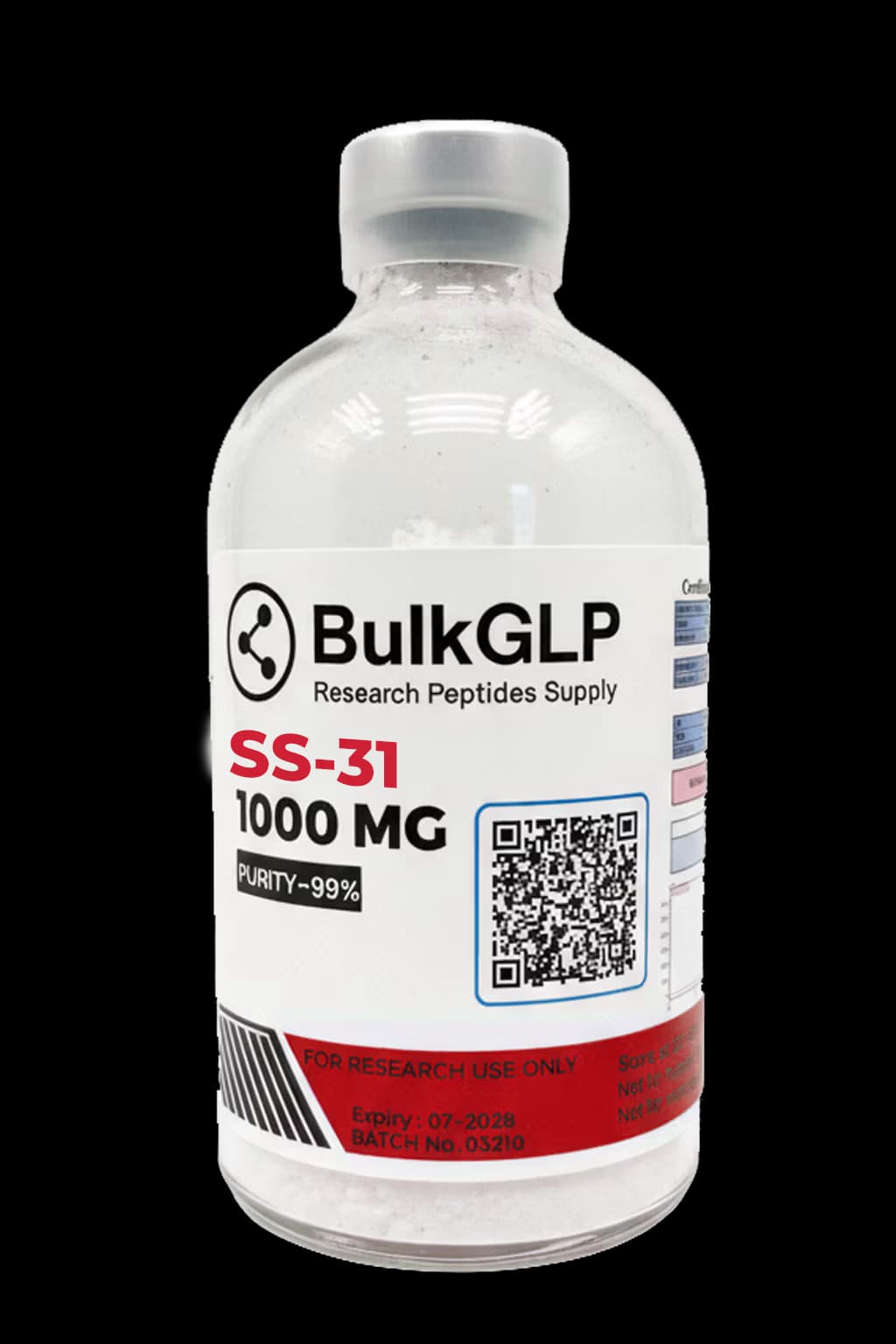
SS-31 Research Powder — 1000mg (1g)
SS-31, also called elamipretide, is listed as raw research powder in a nominal 1000 mg (1 g) quantity. The source identifies it as a four-residue peptide. Confirm available lot documentation and packaging before ordering. For laboratory research only; not for human or veterinary use.
View batch documentationAbout SS-31 powder
SS-31 is the research name for elamipretide, a synthetic tetrapeptide written D-Arg-Dmt-Lys-Phe-NH2, where Dmt is 2,6-dimethyltyrosine. Its identity depends on more than the four residues: the first arginine has the D configuration, the tyrosine ring carries two methyl groups and the C-terminus is amidated. The literature describes it as a mitochondria-targeted peptide that associates with cardiolipin, a phospholipid of the inner mitochondrial membrane.
Here SS-31 comes as raw research powder, priced as a single nominal 1,000 mg (1 g) quantity. Orders are for that full gram; the listing has no smaller split or multi-unit pack. Ask BulkGLP about the available lot and packaging ahead of an order.
- Format
- Research powder
- Sizes
- 1 g
- Ships
- Same business day when paid before 2 PM Central · USPS, UPS or FedEx with tracking
- Storage
- Sealed and dry, typically −20 °C · Storage guide
Research context and material documentation
Separate molecular identity and published research from the format supplied here and the results reported for an individual lot.
SS-31 is the modified tetrapeptide elamipretide
SS-31 is a laboratory designation for elamipretide, a synthetic peptide containing four residues. Its structure is written H-D-Arg-L-Dmt-L-Lys-L-Phe-NH2. Dmt denotes 2,6-dimethyltyrosine, a substituted tyrosine residue. The D configuration of the first arginine, the two methyl substituents and the terminal amide are part of the chemical identity. Replacing this notation with an ordinary four-letter amino acid string would omit those features.
PubChem distinguishes the parent peptide from elamipretide hydrochloride. The parent reference values below exclude counterions and hydration. In particular, the trihydrochloride record has a different formula and molecular weight. A product label or development code cannot establish which chemical form is present in a supplied powder.
Cardiolipin research in defined systems
Birk and colleagues studied SS-31 interactions with cardiolipin-containing membranes using liposomes and bicelles. Their methods included fluorescence measurements, turbidity and nuclear magnetic resonance. They also examined cytochrome c electron-transfer behavior and oxygen consumption in isolated mitochondrial preparations. These experiments provide a concrete context for the term mitochondrial peptide: it refers to the systems investigated, rather than a product performance guarantee.
Membrane composition, buffer conditions and the measured endpoint matter when interpreting this work. Binding to a model membrane, changes in an isolated organelle preparation and a cellular response are different observations. A reference to the published molecule does not demonstrate equivalent behavior, identity or quality for an independently supplied lot.
Analytical checks for a modified peptide
Compare a reported mass with the chemical species actually specified. An LC-MS spectrum may show protonated ions and multiple charge states; a deconvoluted parent mass is different from a raw mass-to-charge peak. The report should identify that convention and give sufficient method information to evaluate the comparison.
Intact mass agreement alone does not resolve D versus L stereochemistry, and it does not locate the methyl groups on the aromatic residue. A complete identity assessment therefore considers how the method addresses the intended modifications. Chromatographic purity and quantitative content add separate information; neither is replaced by a correct nominal mass.
The same principle applies when comparing a raw powder with a formulated preparation. Weighing the preparation measures everything present, whereas a peptide-specific assay targets the defined analyte. Record the reporting basis explicitly so counterion or water contributions are not mistaken for a change in the peptide's molecular identity.
Powder format and laboratory documentation
This catalog format is labeled as nominal 1000 mg, equivalent to 1 g, of research powder. That packaging amount does not change the molecular definition. Confirm whether a quantitative report is expressed on a peptide-moiety basis, a salt basis or an as-received material basis before comparing its result with the label.
Retain the lot identifier, chemical-form specification, analytical method and handling history together. Use documented storage and retest requirements for the actual material. This page supplies no preparation protocol or universal shelf life. Materials are offered for laboratory research only, not human or veterinary use.
Frequently asked questions
Can a trihydrochloride mass be substituted for the parent peptide mass?
Only when the comparison explicitly concerns that salt and its defined stoichiometry. Parent-peptide and whole-salt quantities must not be treated as interchangeable.
Does the SS-31 name identify an approved drug product?
No. A molecular or development name does not establish the formulation, manufacturing controls or approval status of a particular supplied material. This listing is a laboratory research material.
Related research materials
Molecular reference specifications
Reference identities do not establish a supplied lot’s analytical results.
- Reference compound
- Elamipretide; SS-31; modified linear tetrapeptide
- Parent CAS registry number
- 736992-21-5
- Parent molecular formula
- C32H49N9O5
- Parent molecular weight
- 639.8 g/mol (PubChem average molecular weight)
- Reference structure
- H-D-Arg-L-Dmt-L-Lys-L-Phe-NH2; Dmt = 2,6-dimethyltyrosine
- Hydrochloride comparison
- Trihydrochloride: C32H52Cl3N9O5; 749.2 g/mol; a separate reference species
- Supplied salt and water content
- Not established by the parent identifiers; verify lot documentation
Sources: PubChem: elamipretide parent peptide, CID 11764719 (opens in a new tab) · PubChem: elamipretide trihydrochloride, CID 137528200 (opens in a new tab) · Birk et al.: SS-31, cardiolipin and cytochrome c experiments (2014) (opens in a new tab) · USP researchers: reference standards and quality characterization of synthetic peptides (2023) (opens in a new tab)
Editorial review: · BulkGLP.
THE BULKGLP STANDARD
Quality tested.
Confidence delivered.
Our quality program combines independent lab testing for purity, identity and content with published batch reports. See the results behind BulkGLP quality and shop with confidence.
For the limits of a report and the distinction between identity, purity and content, read public analytical verification.
CONTINUE EXPLORING
Related research products.
 In stock
MOTS-c Peptide – Research Vial 10 mg, 20 mg, 40 mg
6 format options
 In stock
GHK-Cu Research Powder — 10g (10,000mg)
 In stock
Thymosin Alpha-1 Research Powder — 1000mg (1g)
 In stock