
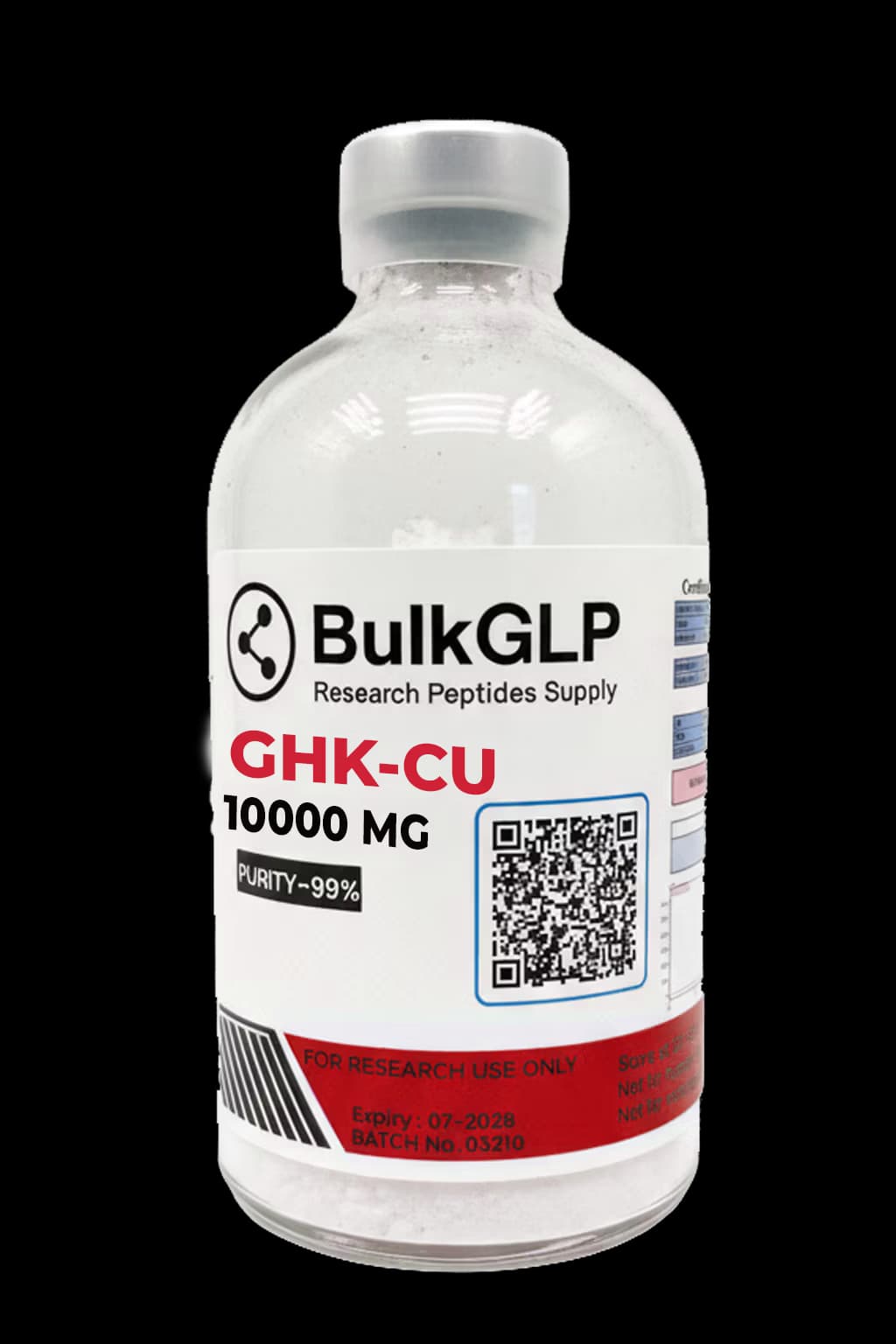
Bulk Raw Research Powders
GHK-Cu Research Powder — 10g (10,000mg)
GHK-Cu raw research powder is listed in a nominal 10 g (10,000 mg) quantity. It is the copper(II) complex of glycyl-L-histidyl-L-lysine. Confirm available packaging and lot documentation against your laboratory requirements before ordering. For laboratory research only; not for human or veterinary use.
View batch documentationAbout GHK-Cu powder
This listing is GHK-Cu as raw research powder, sold in bulk rather than in vials. The compound is the copper(II) complex of the tripeptide Gly-His-Lys, with the peptide acting as the ligand that holds the copper ion. Other names for it are copper tripeptide-1 and prezatide copper.
One unit is a nominal 10 g (10,000 mg) of powder, the same nominal mass as one hundred of the 100 mg GHK-Cu vials. It is sold only as a single unit, with no multi-pack pricing. Bulk powder suits labs that measure out their own working amounts. The listing sits in the Bulk Raw Research Powders category.
- Format
- Research powder
- Sizes
- 10 g
- Ships
- Same business day when paid before 2 PM Central · USPS, UPS or FedEx with tracking
- Storage
- Sealed and dry, typically −20 °C · Storage guide
Research context and material documentation
Separate molecular identity and published research from the format supplied here and the results reported for an individual lot.
GHK-Cu: peptide ligand and copper complex
GHK-Cu denotes a copper(II) complex of the tripeptide glycyl-L-histidyl-L-lysine. The peptide sequence is Gly-His-Lys, abbreviated GHK. The copper-free peptide and a copper-containing complex are different chemical species, so they must not share an unlabeled formula or molecular-weight value. A three-residue sequence describes the ligand; it does not fully describe metal coordination, protonation or the composition of a supplied material.
Public substance records illustrate this distinction. FDA GSRS represents prezatide copper as C14H22N6O4.Cu, while PubChem CID 71587328 represents a positively charged species as C14H23CuN6O4+ with molecular weight 402.92 g/mol. These are explicitly identified reference representations. They do not establish the protonation, counterion, hydration or copper-to-peptide ratio of the current product.
Coordination chemistry in research
GHK copper chemistry has been investigated using solution spectroscopy and structural methods. The solution-structure study by Freedman and colleagues addresses the complex itself. Later work by Bossak-Ahmad and colleagues examines systems containing GHK, copper(II) and another ligand, cis-urocanic acid. Those studies make chemical speciation a relevant research question rather than an assumption that every solution contains a single unchanging complex.
Experimental pH, ligand availability and mixing composition should be recorded when comparing coordination studies. A binary copper-peptide preparation and a system containing competing ligands need not have identical species distributions. For this reason, a biological result reported for one defined preparation cannot automatically be assigned to all materials sold under the general GHK-Cu name.
What an analytical report needs to distinguish
Peptide identity, total copper and metal coordination are separate questions. A mass spectrum detecting free GHK may support the identity of the ligand without establishing the amount of copper in the sample. Likewise, a measurement of total copper alone does not show which ligand binds it. Evaluate the reported analyte and sample treatment before interpreting either result.
The cited coordination research uses complementary methods such as ultraviolet-visible, circular-dichroism and electron-paramagnetic-resonance spectroscopy. These methods investigate different chemical features. Blue appearance is not a substitute for a validated purity, content or stoichiometry measurement. A report should say what was measured and the basis on which its result is expressed.
If a project depends on copper loading, specify that requirement independently of peptide purity. The analytical question should identify the intended copper-to-ligand relationship and whether free copper or free ligand must also be assessed. A single appearance observation or unqualified percentage cannot answer all of those questions.
Product format and documentation
This listing is the catalog's nominal 10 g (10,000 mg) research-powder format. The nominal package amount is a catalog specification, not a measured copper content or a molecular-weight determination. The same scientific reference applies to both GHK-Cu formats, but reports remain specific to their identified sample, lot and formulation.
For laboratory acceptance, match the label to the report and request the actual chemical-form specification where it affects interpretation. Record analytical methods, storage requirements and changes in sample condition. Chromatographic purity does not by itself establish net peptide mass, copper stoichiometry or absence of other material. This reference supplies no universal shelf life or preparation instructions.
Frequently asked questions
Why is 340.38 g/mol not labeled as the GHK-Cu molecular weight?
That value describes copper-free GHK. A copper-containing reference species must be identified separately, including its charge or other compositional qualifications.
Does a blue powder prove the specified complex is present?
No. Appearance can be recorded as an observation, but identity and quantitative composition require appropriate analytical evidence for the submitted material.
Related research materials
Molecular reference specifications
Reference identities do not establish a supplied lot’s analytical results.
- Reference identity
- GHK ligand coordinated to copper(II); prezatide copper / copper tripeptide-1
- Reference CAS registry number
- 89030-95-5 (prezatide copper)
- Peptide ligand sequence
- Gly-L-His-L-Lys (GHK)
- FDA GSRS reference formula
- C14H22N6O4.Cu (UNII 6BJQ43T1I9)
- PubChem comparison species
- C14H23CuN6O4+; 402.92 g/mol; CID 71587328
- Copper-free GHK comparison
- C14H24N6O4; 340.38 g/mol; excludes copper
- Product complex, counterions and hydration
- Not resolved by the reference name; verify the supplied lot specification
Sources: GSRS: prezatide copper, UNII 6BJQ43T1I9 (opens in a new tab) · PubChem: prezatide copper, CID 71587328 (opens in a new tab) · PubChem: copper-free GHK, CID 73587 (opens in a new tab) · Freedman et al.: solution structure of the GHK-copper(II) complex (1982) (opens in a new tab) · Bossak-Ahmad et al.: GHK, copper(II) and cis-urocanic acid coordination (2020) (opens in a new tab)
Editorial review: · BulkGLP.
THE BULKGLP STANDARD
Quality tested.
Confidence delivered.
Our quality program combines independent lab testing for purity, identity and content with published batch reports. See the results behind BulkGLP quality and shop with confidence.
For the limits of a report and the distinction between identity, purity and content, read public analytical verification.
CONTINUE EXPLORING
Related research products.
 In stock
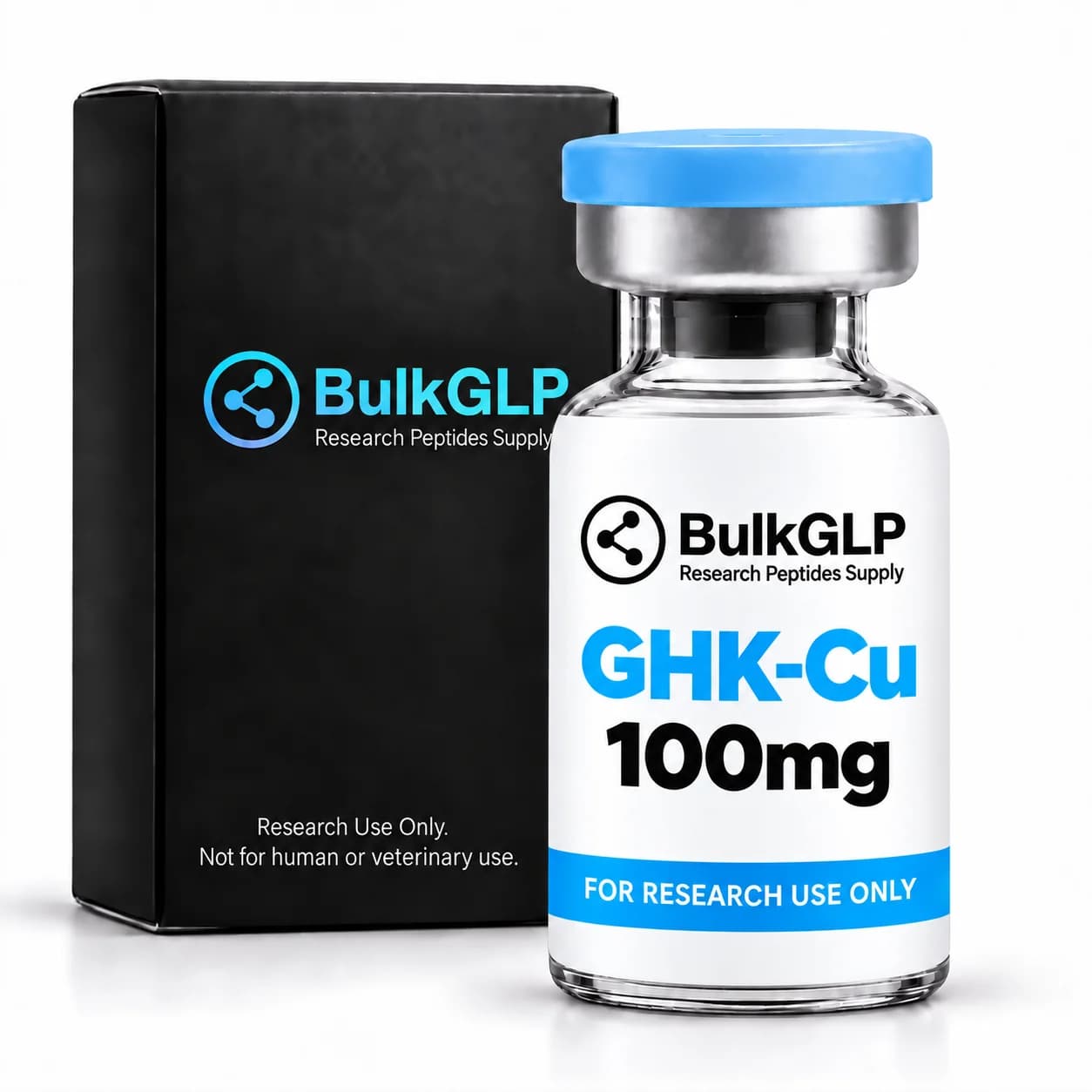
GHK-Cu Peptide (GHKCu) — 100mg Research Vial
2 format options
 In stock
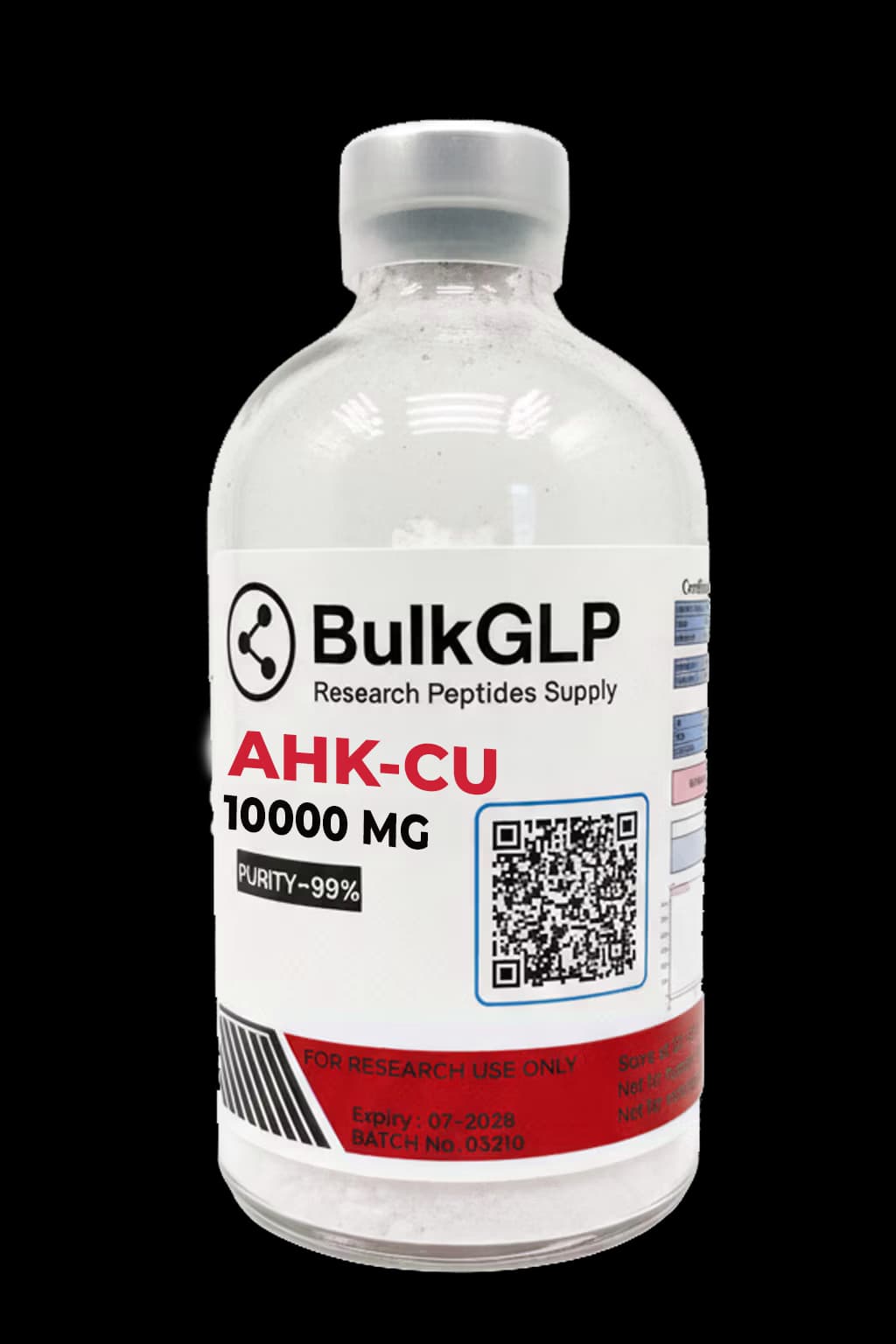
AHK-Cu Research Powder — 10g (10,000mg)
 In stock
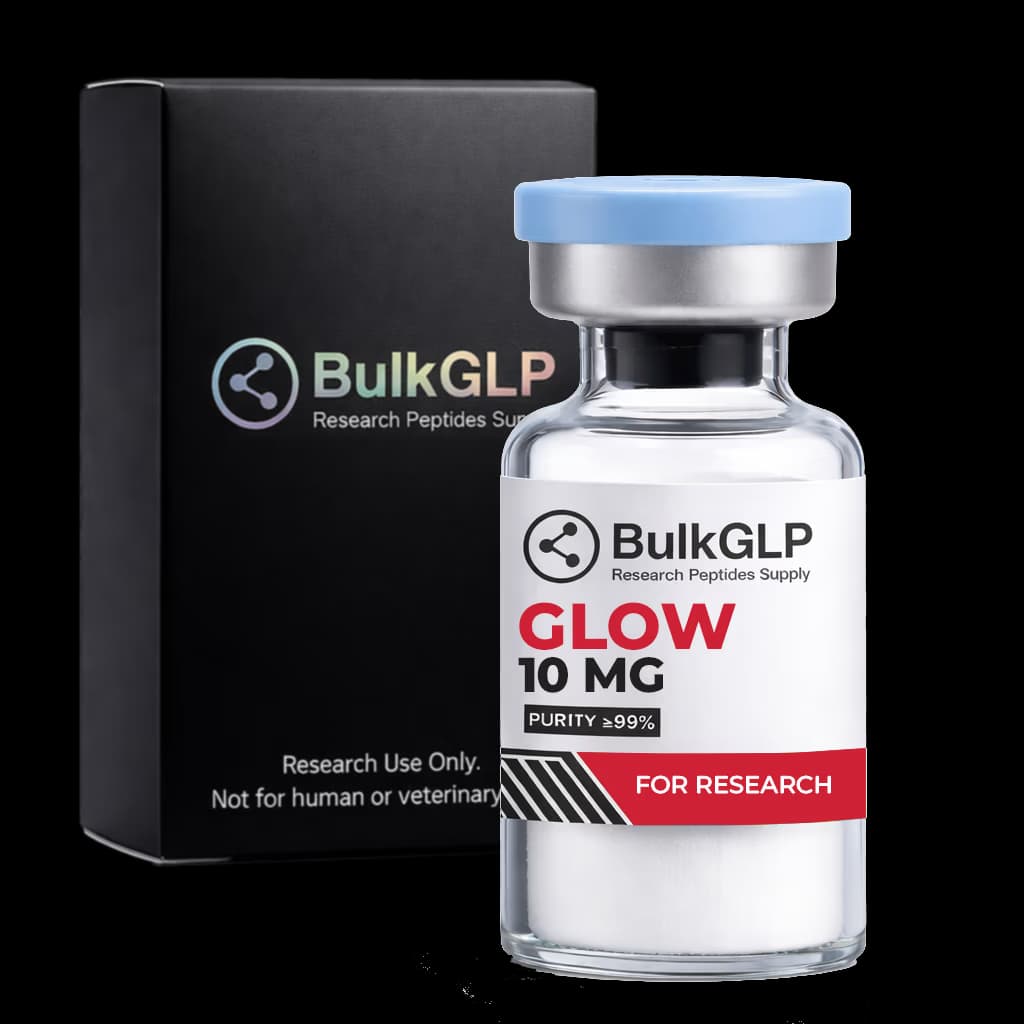
Glow Blend
2 format options
 In stock
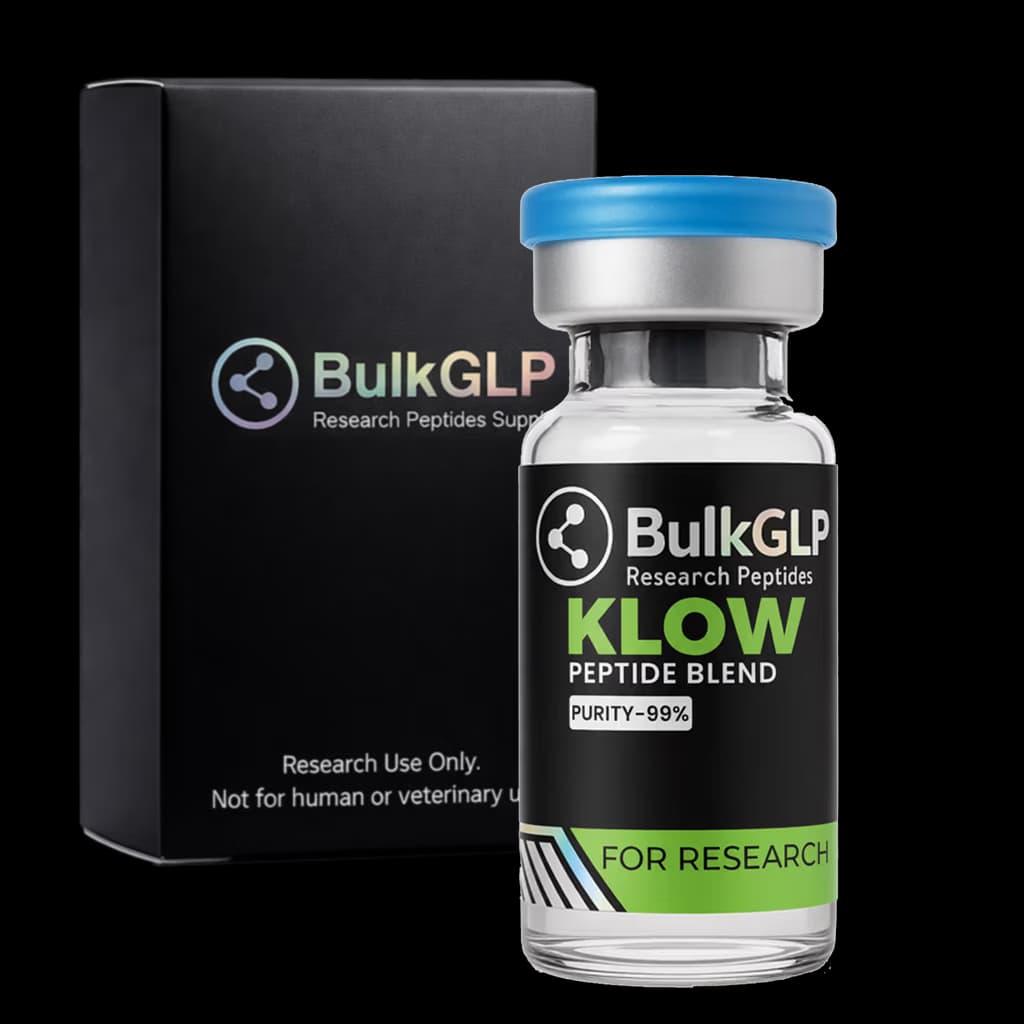
KLOW Peptide – BPC-157, KPV, TB-500, GHK-Cu
2 format options