Retatrutide – Research Peptide (GLP-1 / GLP-3)
Free Priority Shipping on Orders $99+
From $120.00
Third-Party Quality Authentication
Independent Laboratory Verification
Buy Retatrutide Peptide (LY3437943) – Research Vials 10–50 mg
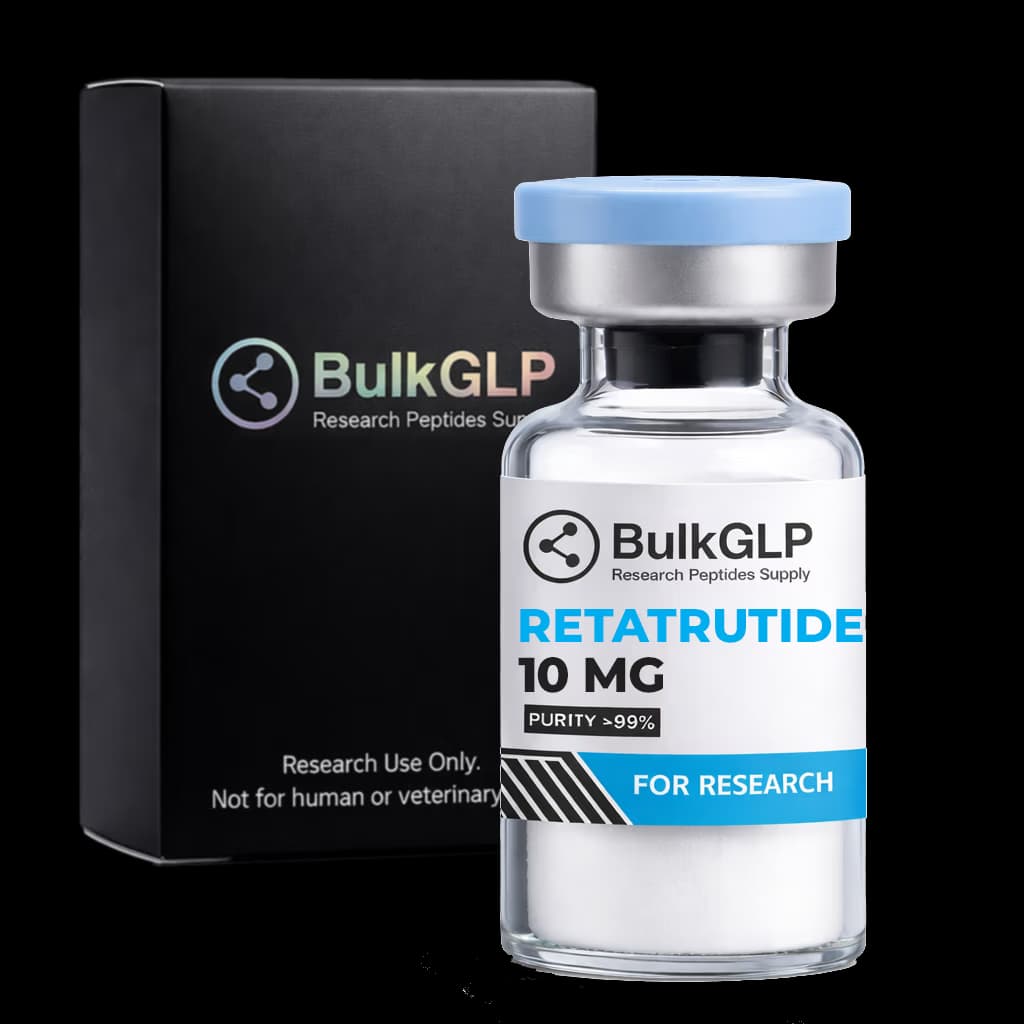
BulkGLP supplies Retatrutide (LY3437943) as lyophilized research vials (10 mg, 15 mg, 20 mg, 30 mg) in both standard and mannitol-free configurations for qualified laboratories. Each production lot is verified to ≥99% purity by independent third-party HPLC/MS, and a current Certificate of Analysis (COA) is published directly on this product page for batch verification.
Product Overview
BulkGLP is a U.S.-based Retatrutide supplier focused on research customers. Orders are fulfilled from U.S. inventory with batch documentation available directly on this page. Purchase through this listing provides access to current lots, including single vials and 10-pack options for ongoing studies.
Batch & Supply Format
- ≥99% purity verified by independent third-party HPLC/MS
- Lyophilized peptide format (available in standard cake and unbulked mannitol-free variants)
- Singles and 10-packs available
- COA transparency: posted on-page for the active lot
- U.S. domestic fulfillment with appropriate packing
What Is Retatrutide (LY3437943)?
Retatrutide (LY3437943) is a synthetic triple-agonist peptide studied in metabolic and receptor-signaling research models for simultaneous activity at:
- GLP-1 receptor — incretin-pathway signaling models
- GIP receptor — complementary incretin signaling research
- Glucagon receptor — energy-balance and lipid signaling models
Supplied for in-vitro/ex-vivo research by qualified laboratories; not for administration to humans or animals.
Mechanistic Overview
- GLP-1 axis: receptor-mediated signaling models and glucose dynamics research
- GIP axis: glucose-dependent signaling pathways and incretin synergy research
- Glucagon axis: lipid mobilization and energy-expenditure pathway modeling
Research Evidence Snapshot
Published preclinical and Phase 2 literature describes metabolic endpoints associated with triple-agonist peptides compared to single- and dual-agonist incretin approaches. Researchers should review primary sources for protocol design, model selection, and methodological details applicable to their work.
Retatrutide vs Tirzepatide vs Semaglutide
| Feature | Retatrutide | Tirzepatide | Semaglutide |
|---|---|---|---|
| Agonism | Triple: GLP-1, GIP, Glucagon | Dual: GLP-1, GIP | Single: GLP-1 |
| Research Focus | Combined receptor-pathway signaling models | Incretin pathway research | GLP-1 axis signaling models |
| Design Notes | Includes glucagon-axis activity in research models | Well-characterized dual incretin profile | Single-pathway incretin agent |
Why BulkGLP
- ≥99% purity: verified by independent third-party HPLC/MS
- Lot transparency: current COA posted on-page
- Lot-consistent availability: singles & 10-packs for ongoing studies
- U.S. fulfillment: domestic inventory and reliable shipping
Format & Handling
- Form: Lyophilized peptide (research vial)
- Formulation Options: Standard (Default) and Mannitol-Free options
- Fill options: 10 mg, 15 mg, 20 mg, 30 mg, 50 mg
Product Specifications
- Name: Retatrutide
- Synonyms: LY3437943
- Purity: ≥99% (independent third-party HPLC/MS)
- Formulation Matrix: Standard lyophilized preparation or pure mannitol-free composition
- Molecular Formula: C₂₂₁H₃₄₂N₄₆O₆₈
- Molecular Weight: ~4,731.33 g/mol
- Intended use: In-vitro/ex-vivo research only
Storage & Stability
- Unreconstituted: Store dry and light-protected
- After reconstitution: 2–8 °C; aliquot to reduce freeze-thaw cycles
- Shelf life: 4 years
Regulatory & Safety
All products are supplied for laboratory and scientific research. Products are not approved for human or veterinary use. End users are responsible for compliance with institutional requirements and applicable laws. Purchase constitutes acceptance of these terms.
Retatrutide FAQ
- What vial sizes and formulations are available?
- Retatrutide research vials are available in 10 mg, 15 mg, 20 mg, 30 mg and 50 mg fills, selectable in standard configuration or ultra-pure mannitol-free specifications.
- Is this fulfilled from within the USA?
- Yes. Orders are fulfilled from U.S. inventory with appropriate packing for the shipment route.
- Do you provide a Certificate of Analysis (COA)?
- Yes. A current, batch-specific COA is posted on this product page for verification.
- Are 10-packs available for ongoing studies?
- Yes. Single vials and 10-pack options are available so labs can match quantities to study design.
Institutional Reagent Evaluation: Procurement Parameters for Retatrutide Supply
Factual Summary: Sourcing high purity Retatrutide LY3437943 for systematic in vitro or laboratory evaluation requires verifying absolute molecular identity through independent analytical datasets. To secure premium Retatrutide for sale, clinical research institutions must mandate lot specific High Performance Liquid Chromatography HPLC and Mass Spectrometry MS documentation. BulkGLP provides uncompromised, pure reagents backed by strict quality controls, domestic temperature managed logistics, and a transparent chain of custody.
The key takeaway is that achieving absolute experimental reproducibility depends entirely on utilizing unbulked research peptides that are strictly isolated from consumer facing channels. BulkGLP reinforces this vector space separation from commodity dietary wellness brands by operating a dedicated business to business framework from our central Dallas Texas headquarters.
Molecular Profile and Structural Integrity Standards
Retatrutide CAS Registry Number 2381089 83 2 is a highly modified synthetic 39 amino acid peptide backbone engineered to display co agonist activity across three distinct incretin receptor networks. Structurally derived from the native glucose dependent insulinotropic polypeptide GIP sequence, its topology incorporates specific non coded substitutions to optimize metabolic stability and enzymatic resistance against dipeptidyl peptidase 4 cleavage.
The structural configuration features alpha aminoisobutyric acid insertions at critical enzymatic targets and a specialized C terminal amidation. The backbone is acylated at the Lysine residue at position 20 with a C20 fatty diacid moiety via a hydrophilic gamma glutamyl linker system. This structural modification dictates its binding kinetics and lipophilic affinity properties in cellular assay matrices.
When assessing a commercial price framework against current chemical synthesis standards, researchers must evaluate raw mass data rather than unverified bulk weight. Standard lyoprotectants or bulking agents such as mannitol or glycine can artificially inflate vial weight, leading to systematic calculation errors during volumetric master batching or molar concentration adjustments. BulkGLP eliminates this structural variance by distributing entirely unbulked lyophilized cakes, ensuring that the target mass represents exclusively pure peptide vectors.
| Analytical Metric | Preclinical Requirement | BulkGLP Laboratory Specification |
|---|---|---|
| Chemical Identity | CAS Registry Number 2381089 83 2 | Confirmed Structural Topology |
| Molecular Formula | C221H342N48O68 | Absolute Alignment via LC MS Analysis |
| Purity Threshold | High Performance Liquid Chromatography | Chemical Purity 99 percent or Greater |
| Physical Matrix | Lyophilized Peptide Cake | Vacuum Sealed with Zero Structural Fillers |
Downstream Intracellular Signaling and Receptor Affinities
The operational framework of Retatrutide relies on its balanced but distinct potency profiles across the human glucagon like peptide 1 receptor GLP1R, glucose dependent insulinotropic polypeptide receptor GIPR, and glucagon receptor GCGR. Unlike single target mono agonists, this triple receptor agonist system triggers concurrent intracellular transduction pathways via cyclic adenosine monophosphate cAMP accumulation and beta arrestin recruitment assays.
- GIPR Activation: Retatrutide acts as a potent full agonist at the GIP receptor, displaying a high baseline affinity profile that mimics native GIP signaling to stabilize intracellular cyclic AMP levels in islet cellular models.
- GLP1R Co Agonism: At the GLP1 receptor, the compound exhibits an engineered potency curve that provides sustained cellular signaling activation, reinforcing downstream insulin secretion pathways under glucose dependent conditions.
- GCGR Recruitment: Activation of the glucagon receptor pathway marks a critical milestone in metabolic research, driving downstream signals associated with glucagon receptor mediated thermogenesis, accelerated resting energy expenditure, and direct hepatic lipid oxidation models.
Because these receptor networks exhibit distinct binding affinities, background chemical impurities or truncated peptide fragments can introduce significant noise into cellular assays. Unverified residual synthesis materials can distort measurements of receptor mediated pathways. To mitigate these experimental variables, BulkGLP utilizes an exclusive manufacturing partnership engineered around a robust Dual Tier Batch Verification protocol. Every single lot is synthesized under tightly regulated environments, isolated via preparative chromatography, and independently audited before distribution. For immediate access to raw batch tracking records, current chromatography data, or customized volume based pricing profiles, research facilities can connect directly with our domestic support desk at 972 767 9536.
Lyophilization Matrix Dynamics and Volumetric Reconstitution Metrics
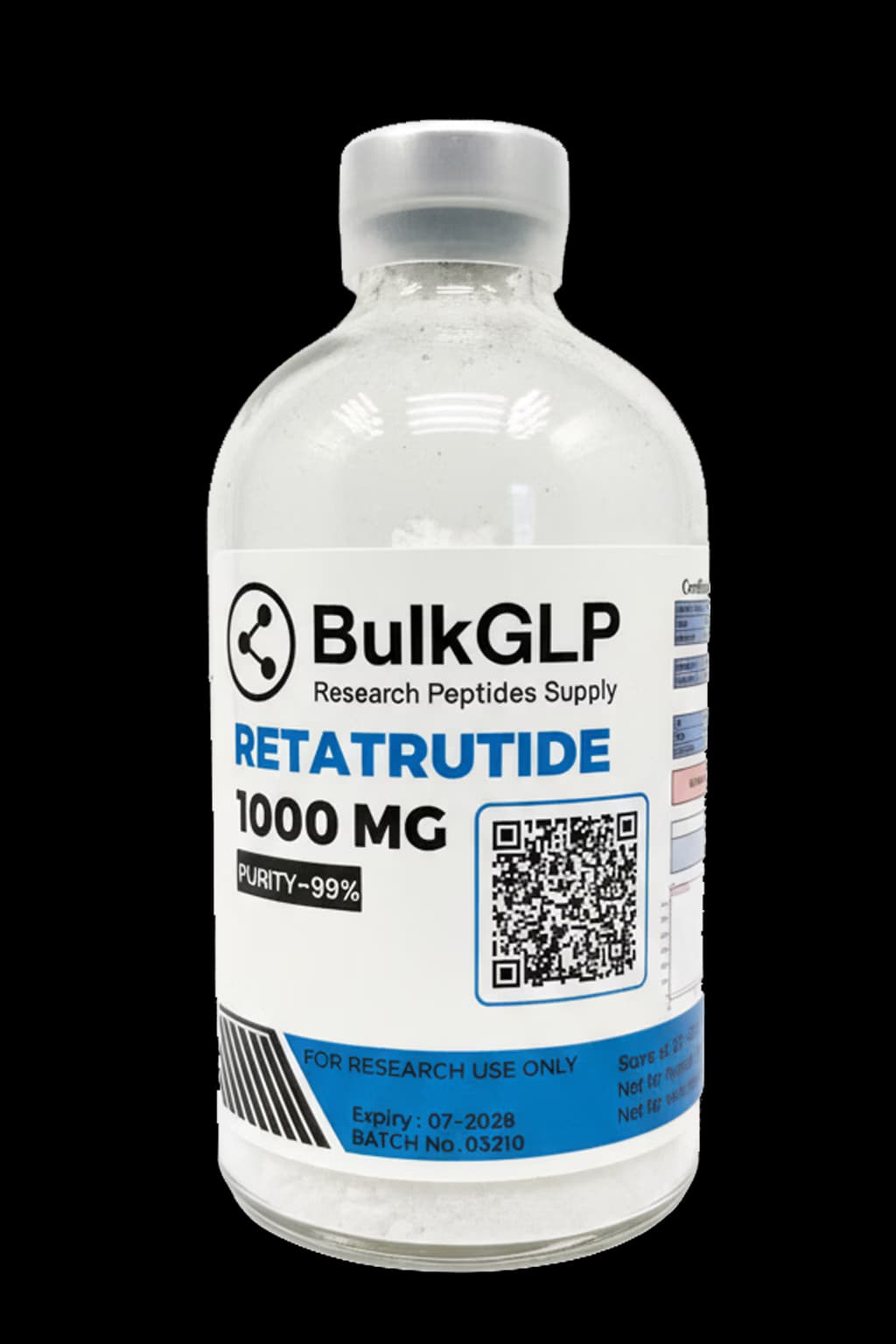
The physical preservation of Retatrutide involves a precise lyophilization freeze drying configuration executed within scientific grade laboratory parameters. Sublimation schedules are strictly maintained to remove all residual moisture from the glass vial container without introducing thermal stress to the peptide chain. This processing produces a uniform structural white cake that dissolves instantly upon fluid contact.
To accurately transition the dry lyophilized material into an active solution for evaluation, laboratory managers must adhere to strict volumetric stoichiometry calculations. Reconstitution should always be completed under aseptic laminar flow environments using a calibrated digital repeater pipette. Introduce the fluid down the internal glass wall of the vial rather than dropping it directly onto the lyophilized cake. Allow the vial to rest undisturbed for 180 seconds, followed by a gentle, slow, planar rotation. Never shake, agitate, or subject the reconstituted vial to violent mechanical mixing, as physical shear forces can warp the delicate secondary conformation of the triple agonist sequence, rendering the compound unviable for signaling observations.
The matrix below outlines the specific diluent configurations required to establish precise working concentrations across all five standard mass distributions available in our catalog, including our high volume 50mg configuration:
| Vial Size Target Mass | Bacteriostatic Water Added | Resulting Working Concentration |
|---|---|---|
| 10mg Reagent Vial | 2.0 mL | 5.0 mg per mL working concentration |
| 15mg Reagent Vial | 3.0 mL | 5.0 mg per mL working concentration |
| 20mg Reagent Vial | 2.0 mL | 10.0 mg per mL working concentration |
| 30mg Reagent Vial | 3.0 mL | 10.0 mg per mL working concentration |
| 50mg Reagent Vial | 5.0 mL | 10.0 mg per mL working concentration |
Laboratory Storage, Aliquoting, and Degradation Mitigation
Longitudinal evaluation parameters mandate strict adherence to thermal control boundaries to prevent premature chemical degradation, hydrolysis, or amino acid racemization pathways over elongated timelines:
- Lyophilized Preservation: Unreconstituted vials must be stored in a specialized ultra low temperature freezer environment maintained at or below 20 degrees below zero. For multi year archive sequences, extreme low temperature storage is required to guarantee complete immobilisation of degrading chemical channels. Protect all vials entirely from direct ultraviolet or ambient light exposure.
- Liquid Stability Constraints: Following fluid introduction, active working solutions must be kept strictly within a narrow refrigeration range of 2 to 8 degrees Celsius. Solutions must never be allowed to undergo repetitive freeze thaw cycles, as the formation of ice crystals mechanically disrupts the peptide chain.
- Aliquoting Best Practices: To prevent continuous entry into a single primary container, investigators should split the initial reconstituted volume into separate sterile single use micro centrifuge tubes. This isolates individual testing batches, ensuring that secondary fractions remain completely unexposed to room temperature fluctuations or ambient contaminants.
| Weight | 0.1 lbs |
|---|---|
| Dimensions | 2 × 2 × 2 in |
| Size | 5mg, 10mg, 12mg, 15mg, 20mg, 30mg, 50mg, 5mg – 10 Pack, 10mg – 10 Pack, 15mg – 10 Pack, 20mg – 10 Pack, 30mg – 10 Pack |
| Formulation | Standard (Default), Mannitol Free |