Research scope: This page explains the identity, receptor profile, and development status of retatrutide as of July 24, 2026. It is intended for scientific and laboratory-reference purposes only. It does not provide medical, dosing, administration, or treatment guidance.

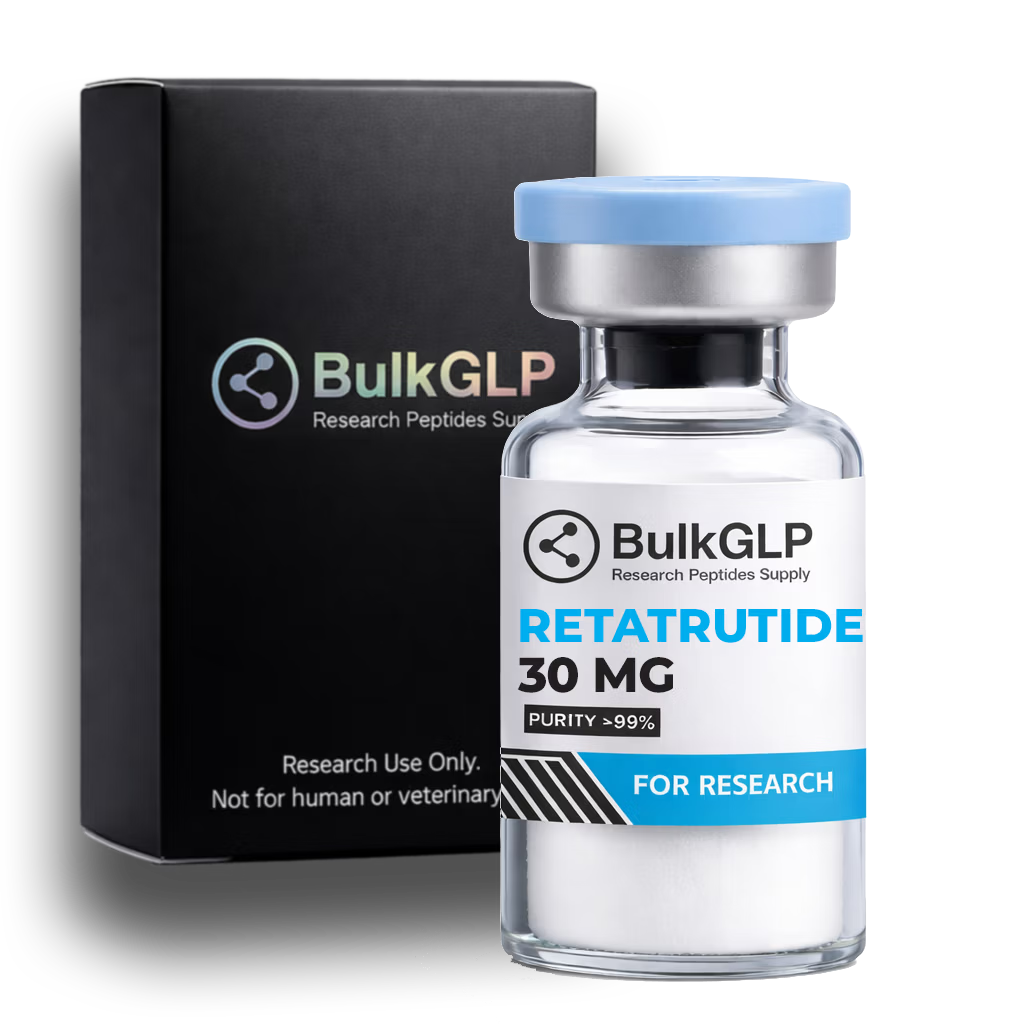
Retatrutide is the nonproprietary name commonly used for LY3437943, an investigational peptide developed by Eli Lilly and Company. It is described scientifically as a single-molecule triple agonist because it activates the glucose-dependent insulinotropic polypeptide receptor (GIPR), glucagon-like peptide-1 receptor (GLP-1R), and glucagon receptor (GCGR).

Those three targets distinguish retatrutide from single-receptor and dual-receptor incretin compounds. They do not make retatrutide an approved medicine, establish that a separately manufactured research material is equivalent to Lilly’s clinical-trial material, or determine how a material should be used in an experiment. For related terminology, see the retatrutide peptide research overview.

What Is Retatrutide (LY3437943)?

Retatrutide is one modified peptide chain designed to act as an agonist at three receptor systems. An agonist binds to a receptor and promotes receptor signaling. In a controlled study, researchers can examine that signaling through receptor-binding assays, concentration-response experiments, downstream messenger measurements, or model-specific biological endpoints.

The accepted receptor nomenclature is:

  • GLP-1R: glucagon-like peptide-1 receptor
  • GIPR: glucose-dependent insulinotropic polypeptide receptor
  • GCGR: glucagon receptor

Retatrutide is therefore best described as a GIPR/GLP-1R/GCGR triple agonist. Reporting the receptors explicitly is more accurate than relying on informal generational labels.

Does “GLP-3” Mean a Third GLP Receptor?

No. “GLP-3” is a colloquial label sometimes used in online catalogs, media, and general discussion for a compound that engages three hormone-receptor pathways. It is not the formal name of retatrutide, does not identify a recognized “GLP-3 receptor,” and is not the terminology used in the primary discovery literature.

Lilly likewise describes “GLP-3” as a scientifically inaccurate nickname. Scientific records, product documentation, and study reports should use retatrutide, LY3437943, or GIPR/GLP-1R/GCGR triple agonist. When the colloquial term must be mentioned for search or catalog clarity, it should be explained rather than presented as a receptor name.

Why the Three-Receptor Profile Matters in Research

Multi-receptor activity creates additional experimental questions. A downstream response observed after exposure to retatrutide cannot automatically be assigned to GLP-1R, GIPR, or GCGR. Receptor expression, relative potency, signaling bias, exposure time, concentration, and interactions between pathways can all affect the result.

Useful study designs may therefore include receptor-selective comparators, receptor-null controls, antagonists, or separately characterized model systems. The purpose is not simply to ask whether a response occurred, but to determine which receptor or combination of receptors contributed to it.

Retatrutide Compared with Semaglutide and Tirzepatide

Research compound Primary receptor profile Common comparative role
Semaglutide GLP-1R agonist Single-receptor incretin-pathway comparator
Tirzepatide GIPR and GLP-1R agonist Dual-receptor comparator
Retatrutide GIPR, GLP-1R, and GCGR agonist Triple-receptor test article requiring GCGR-aware controls

This comparison describes receptor targets, not medical superiority or interchangeability. The molecules differ in sequence, receptor pharmacology, exposure characteristics, and development status. Data from one compound cannot be converted into instructions for another, and clinical-trial findings do not establish the performance of an independently supplied research lot.

Current Investigational Status as of July 24, 2026

Retatrutide remains investigational and is not approved by the FDA or another regulatory agency. Lilly states that it is not available for public use and continues to be evaluated in Phase 3 clinical programs.

By July 24, 2026, Lilly had disclosed results from five Phase 3 trials, including TRIUMPH-1, TRIUMPH-2, TRIUMPH-3, TRIUMPH-4, and TRANSCEND-T2D-1. Additional trials remain underway. Results announced through company releases are topline findings unless and until detailed data are presented at a scientific meeting or published in a peer-reviewed journal.

On July 23, 2026, Lilly stated that it plans to submit a Biologics License Application for retatrutide in the first quarter of 2027. A planned future application is not an approval, does not guarantee approval, and does not change retatrutide’s current investigational status. See Lilly’s medically reviewed current retatrutide status summary.

Evidence Timeline

  1. 2022: The discovery and early proof-of-concept paper characterized LY3437943 as an agonist at GCGR, GIPR, and GLP-1R and reported preclinical and Phase 1 observations.
  2. 2023: A randomized Phase 2 trial was published in the New England Journal of Medicine, establishing a peer-reviewed human-study record and supporting continued clinical investigation.
  3. 2023 onward: Lilly expanded development into the TRIUMPH and TRANSCEND Phase 3 programs across several study populations and research questions.
  4. December 2025 through July 2026: Lilly announced topline findings from five Phase 3 trials. Some detailed results have been presented or published, while other complete datasets remain pending.
  5. Next regulatory step: Lilly has announced a planned first-quarter 2027 U.S. submission. Regulatory review would occur only after submission and does not have a predetermined outcome.

Research-Material Identity and Quality Control

A label reading “retatrutide” or “LY3437943” does not by itself establish molecular identity, purity, content, formulation, or equivalence to material used in a published study. Each research lot must be evaluated on its own documentation and analytical evidence.

A fit-for-purpose review may include:

  • Mass spectrometry or another mass-confirming identity method
  • A documented chromatographic method for related-substance purity
  • A separate quantitative assay when peptide content matters
  • Formulation, counter-ion, residual-water, and excipient disclosure
  • Residual-solvent, endotoxin, or microbiological results when relevant and actually tested
  • Lot number, test date, laboratory identity, and document traceability

An HPLC area percentage should not automatically be interpreted as peptide amount by weight. Identity, chromatographic purity, quantitative content, formulation, and microbiological attributes answer different questions. A result for one lot should not be carried forward to another lot.

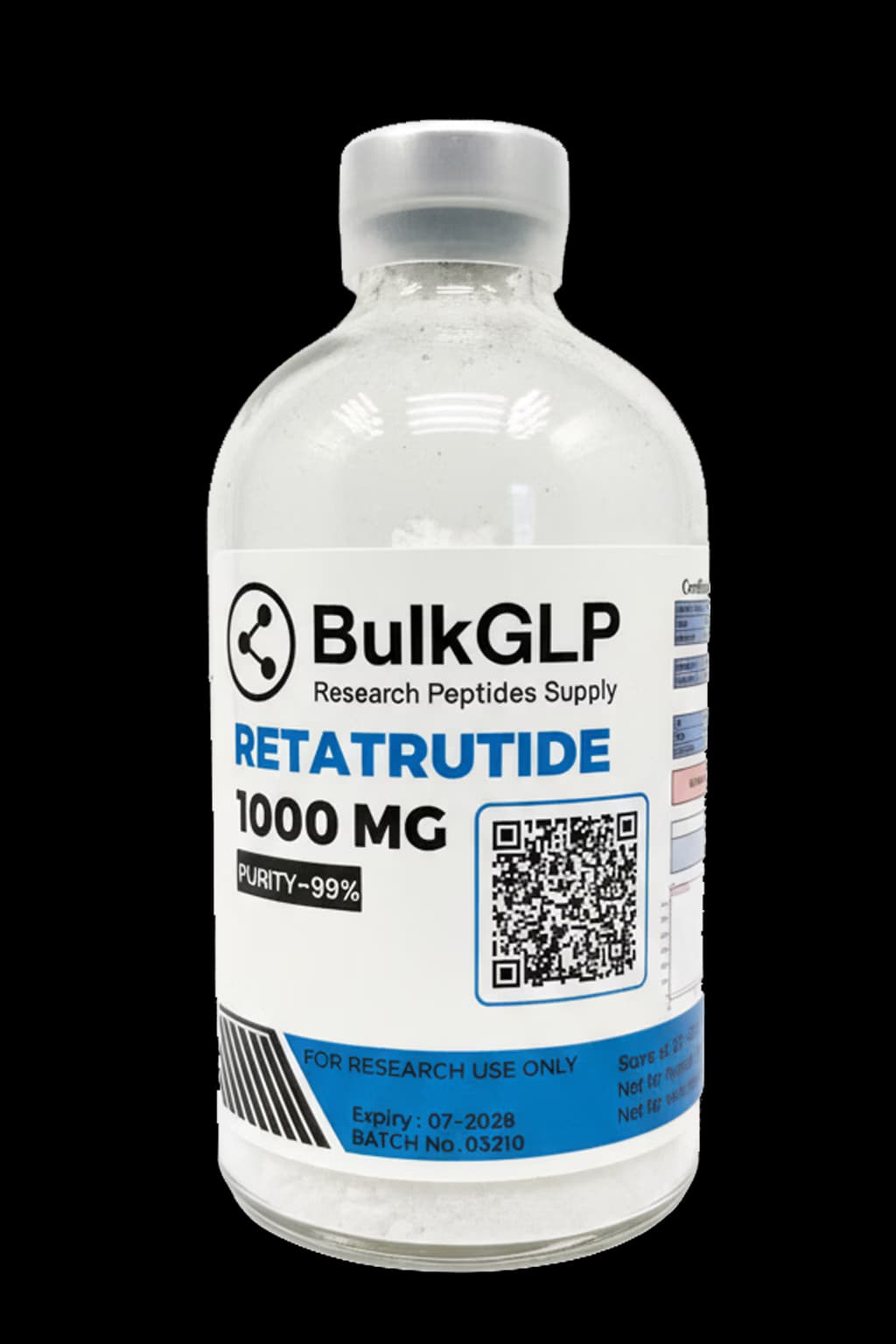
BulkGLP’s documentation process is described on the Verified Quality page. Available formats and active-lot records are displayed separately on the canonical retatrutide research material listing. Research materials shown there are not Lilly clinical-trial products and must not be represented as approved medicines or clinical equivalents.

Frequently Asked Questions

What is retatrutide in one sentence?

Retatrutide, also known as LY3437943, is an investigational single-peptide agonist at GIPR, GLP-1R, and GCGR.

Is retatrutide scientifically called GLP-3?

No. “GLP-3” is informal shorthand, not a recognized receptor or formal scientific name. “Triple agonist” is the more accurate description.

Is retatrutide the same as semaglutide or tirzepatide?

No. Semaglutide primarily targets GLP-1R, tirzepatide targets GIPR and GLP-1R, and retatrutide targets GIPR, GLP-1R, and GCGR. They are distinct molecules.

Is retatrutide FDA approved?

No. As of July 24, 2026, retatrutide remains investigational. Lilly’s announced plan for a 2027 regulatory submission does not constitute approval.

Does a COA prove equivalence to clinical-trial retatrutide?

No. A COA can report results for the tested sample and methods. It does not establish equivalence to Lilly’s manufacturing process, formulation, quality system, or clinical-trial material.

Is this page providing medical-use information?

No. This page is limited to scientific identity, receptor nomenclature, research status, and analytical-documentation concepts. It contains no dosing, administration, diagnostic, or treatment guidance.

Primary Sources

Research use only. Materials discussed on this page are not for human or veterinary use, consumption, diagnosis, treatment, or administration.

Get 10% Off Your Order!

Join our list and get an instant discount code.

You're In!

Use this code at checkout:

Get 10% Off
Get 10% Off
0