
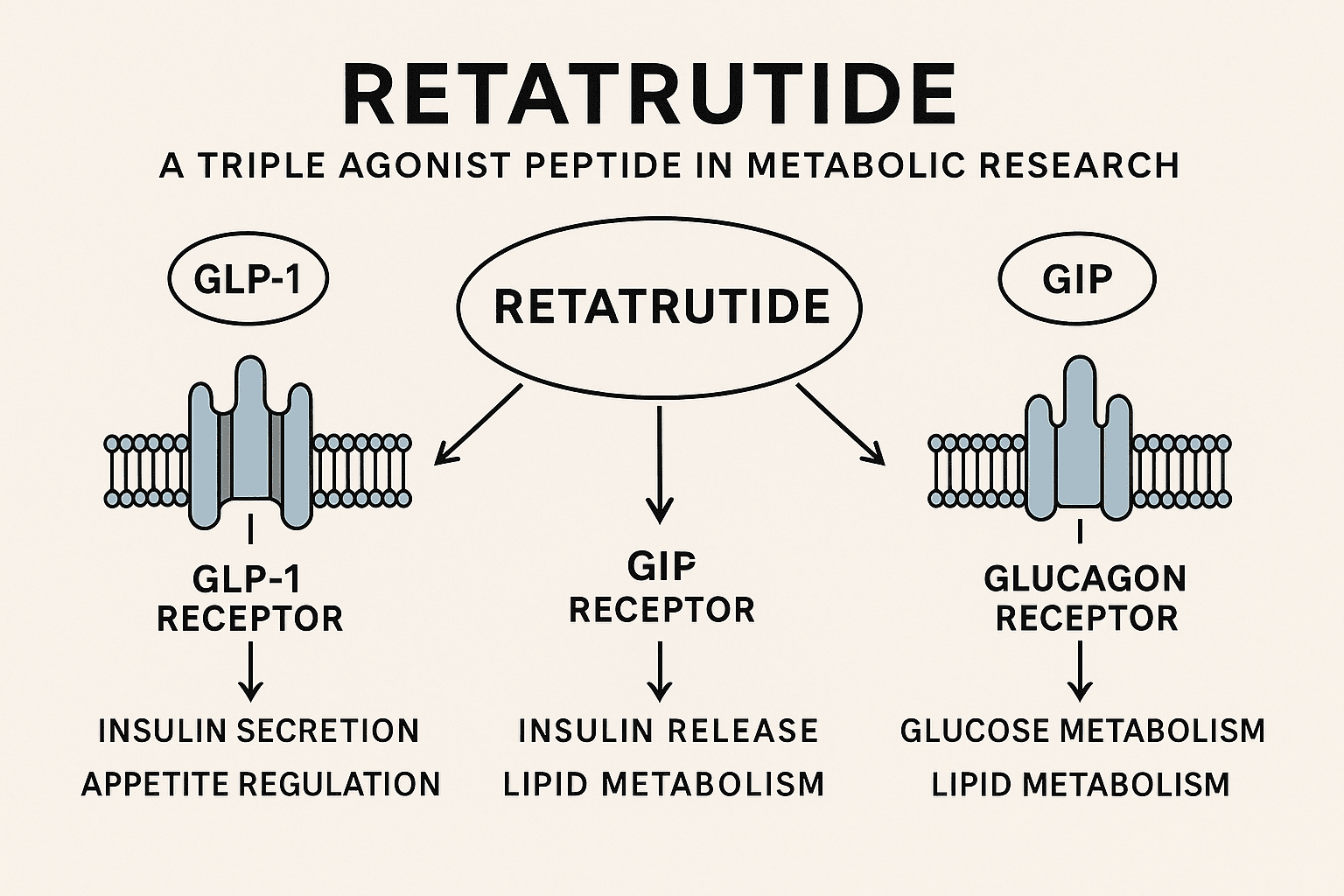
Research scope: Retatrutide (LY3437943) is an investigational peptide studied for agonism at the GIP, GLP-1, and glucagon receptors. This page focuses on receptor biology and experimental interpretation, not dosing, administration, or medical use.
The phrase triple agonist describes receptor coverage. It does not mean that all three receptors are activated with identical potency, kinetics, or signaling bias, and it does not allow a downstream response to be assigned to one receptor without appropriate controls.
The three receptor systems
- GLP-1 receptor (GLP-1R): a class B G-protein-coupled receptor commonly studied through cAMP and related signaling readouts.
- GIP receptor (GIPR): another incretin-family receptor with tissue- and model-dependent expression and signaling.
- Glucagon receptor (GCGR): a related receptor whose inclusion distinguishes retatrutide from GLP-1R-selective and GIPR/GLP-1R dual agonists.
Retatrutide can therefore be useful in models designed to examine multi-receptor signaling. The same feature also raises the bar for controls: receptor expression, ligand concentration, exposure time, system bias, and assay window can all change the apparent contribution of each pathway.
Research questions suited to a triple-agonist model
- How does adding GCGR engagement change a response observed with a GIPR/GLP-1R dual agonist?
- Do the receptors produce additive, opposing, or context-dependent signaling in the selected model?
- How do potency and maximal response change across receptor-specific reporter systems?
- Does chronic exposure alter receptor desensitization, internalization, or downstream transcriptional readouts?
- Which observations persist when one receptor is absent, blocked, or expressed at a different level?
Controls that improve interpretability
A single retatrutide condition cannot separate GLP-1R, GIPR, and GCGR contributions. Depending on the question, a defensible design may include receptor-selective reference ligands, receptor-null or knockdown models, antagonist controls, matched vehicle controls, and concentration-response curves.
Document receptor expression and passage history for cell systems. Report the readout, normalization method, exposure window, number of independent experiments, and predefined exclusion criteria. When comparing lots or compounds, hold formulation, matrix, plate, temperature, and handling variables constant wherever possible.
Material identity and analytical evidence
Receptor pharmacology is only interpretable when the test article is adequately characterized. Review a lot-matched chromatographic result, a mass-confirming identity result, the formulation disclosure, and a quantitative assay when actual content matters. HPLC area percentage, molecular mass, and peptide content are separate measurements.
Use the lot-specific COA and SDS with your laboratory’s validated method. Avoid treating cake appearance, a generic sitewide purity statement, or a single analytical number as complete characterization. BulkGLP’s Verified Quality page describes the available documentation.
Separating receptor evidence from clinical evidence
In-vitro receptor activity, animal-model observations, and human clinical outcomes are different evidence layers. A receptor assay can establish activity under the assay conditions; it cannot establish clinical safety or efficacy. Retatrutide remains investigational and is not an FDA-approved drug.
For current regulatory context, see the FDA’s information on unapproved GLP-1 products and retatrutide.
Primary literature
- Phase 2 publication describing retatrutide’s GIP, GLP-1, and glucagon receptor agonism.
- Receptor pharmacology of the GIPR/GLP-1R dual agonist LY3298176.
- Semaglutide (NN9535) as a GLP-1 receptor agonist reference.
Research use only. Materials discussed here are not for human or veterinary use.
Evidence map for Retatrutide research
The published evidence is not one bucket. Biochemical and cell assays describe receptor activity under a defined assay system. Nonclinical models test questions inside a particular animal, tissue, or organoid model. Clinical papers report results from enrolled participants under a protocol. Trial registries document planned or ongoing work, but a registry entry is not a published result.
Names and receptor measurements
The phrase GLP 3 appears informally online, but it is not a recognized receptor designation. Retatrutide research concerns activity at the GIP, GLP 1, and glucagon receptors. Apparent receptor weighting depends on the assay. Receptor density, overexpression, cell background, reference agonist, and readout timing can move a potency estimate, so one assay value should not be treated as a universal property.
A sound experiment defines the hypothesis, primary readout, exclusions, technical replication, biological replication, reference curve, and analysis before the result is interpreted. Model limits and unresolved questions belong in the record with the positive findings.
Published papers and active registries
- Coskun and colleagues, Cell Metabolism, 2022 reports the discovery work and early clinical proof of concept. It establishes study evidence under the methods described in that paper, not the attributes of a third party research lot.
- Rosenstock and colleagues, The Lancet, 2023 reports a phase 2 trial in type 2 diabetes. Its results belong to that population, protocol, and analysis.
- ClinicalTrials.gov NCT04881760 carries the phase 2 obesity study registry and linked study materials. Registration documents the protocol record; the linked publication carries the reported results.
- ClinicalTrials.gov NCT06383390 is a phase 3 outcomes study registry. An active registry describes planned research and does not establish an outcome before results are reported.
Analytical traceability is a separate evidence layer
A literature citation cannot authenticate a research vial. Compound identity, quantitative content, chromatographic purity, formulation, endotoxin result, microbial result, and sterility are separate questions. An endotoxin result does not establish sterility. Each claim needs a suitable method, an identified sample, and a traceable lot record.
FDA Q2(R2) describes principles for analytical procedure validation, including specificity, accuracy, precision, range, and the procedure’s fitness for its intended purpose. In regulated nonclinical laboratory work, 21 CFR 58.105 requires documentation of each test and control article batch’s identity, strength, purity, composition, and other characteristics that define the article.
Those standards do not turn a supplier report into clinical evidence. They explain why the method, sample identity, lot number, and complete source record matter when a laboratory evaluates research material.