
All Products
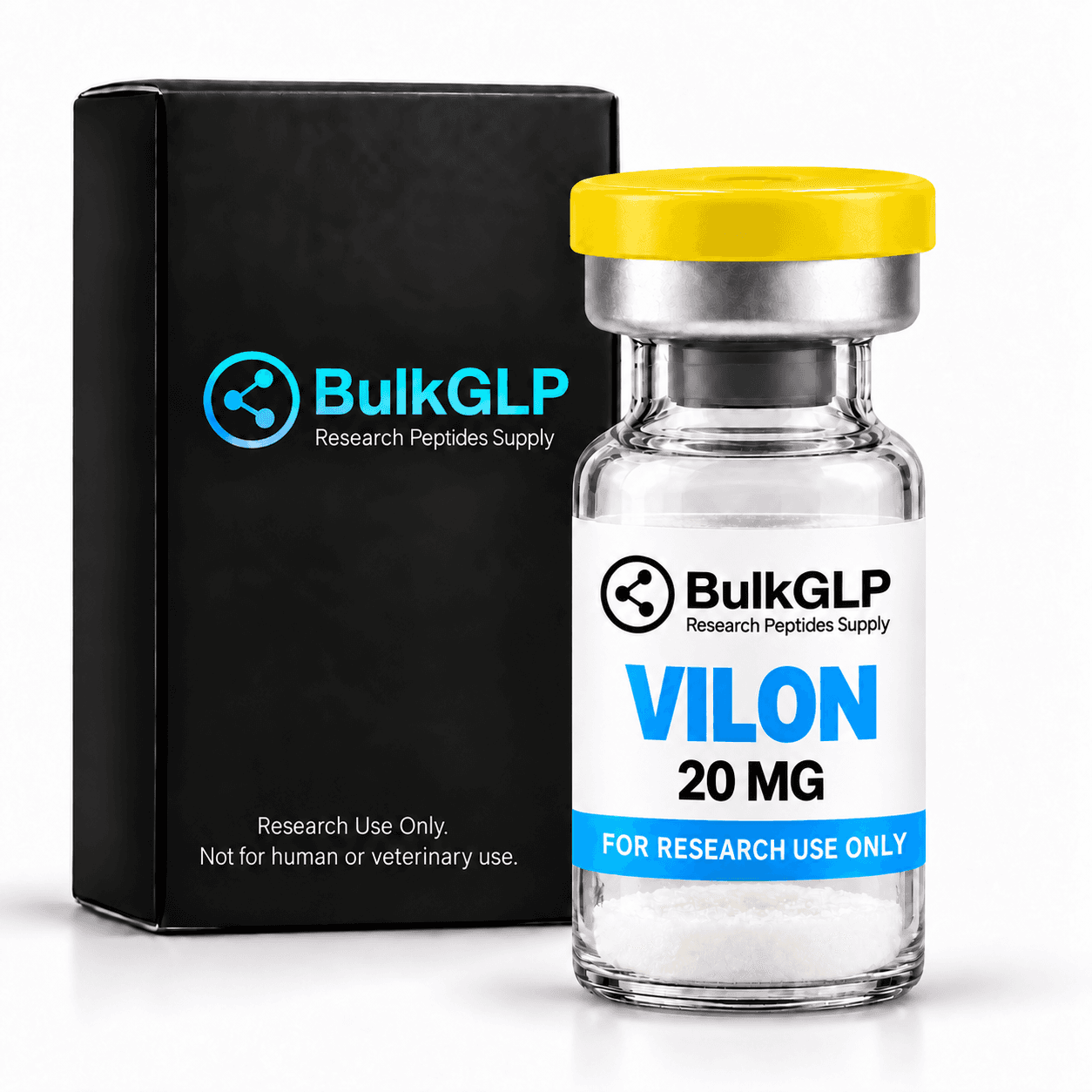
Vilon Peptide — 20mg
Vilon is a synthetic research dipeptide with the amino-acid sequence Lys–Glu (KE). This listing provides 20mg nominal content in one research vial. Published laboratory studies investigate Vilon in immune-cell signaling, gene-expression and cellular-senescence models. Not for human or veterinary use.
View batch documentationVilon peptide identity and specifications
Vilon is a synthetic dipeptide composed of lysine and glutamic acid in the sequence Lys–Glu. Its one-letter sequence is KE: K denotes lysine, and E denotes glutamic acid. This sequence distinguishes Vilon from longer thymic peptides and peptide mixtures.
| Compound | Vilon |
|---|---|
| Peptide class | Synthetic dipeptide |
| Sequence | Lys–Glu (KE) |
| Nominal content | 20mg per vial |
| Sale unit | One research vial |
| Intended use | Laboratory research only |
Vilon in immune-cell and gene-expression research
Primary research has examined Vilon in mouse thymocytes, including cell proliferation and sphingomyelin-related signaling. Another study investigated interleukin-2 messenger RNA in mouse splenocytes.
These are experimental cell and tissue models. Their findings provide a research context for the compound; they do not establish clinical benefits or a human-use protocol.
KE and cellular-senescence studies
A comparative study of KE and AED peptides examined cultured human skin fibroblasts during replicative aging. The researchers assessed proteins involved in inflammatory signaling, collagen expression and sirtuin pathways.
The sources below identify the experimental models and questions studied. They are separate from lot-specific product testing. The listed 20mg is nominal formulation content, not an independently measured assay result for this stock.
Frequently asked questions
What is Vilon peptide?
Vilon is a synthetic dipeptide with the sequence Lys–Glu. It is discussed in research on cell signaling, gene expression and cellular senescence.
What does KE mean?
KE is the one-letter amino-acid sequence for Vilon. K represents lysine and E represents glutamic acid.
Is Vilon the same as Thymalin or thymosin alpha-1?
No. Vilon is the defined Lys–Glu dipeptide. Thymalin is a thymus-derived polypeptide preparation, whereas thymosin alpha-1 is a distinct 28-amino-acid peptide. These names identify different research materials.
What does quantity one contain?
One nominal 20mg Vilon research vial. The listed price is per vial; the product is not a ten-vial kit.
Research references
- Vilon, thymocyte proliferation and cell signaling — primary study (opens in a new tab)
- Vilon and interleukin-2 gene expression — primary study (opens in a new tab)
- Comparison of KE and AED in cultured skin fibroblasts — 2020 study (opens in a new tab)
- Thymalin polypeptide preparation identity — primary study (opens in a new tab)
- Original thymosin alpha-1 amino-acid sequence paper (opens in a new tab)
Related research materials
PRODUCT & LOT INFORMATION
Product documentation
Amounts are nominal formulation content, not independently measured results for this stock. No lot-specific certificate of analysis is currently linked to this listing. For laboratory research only; not for human or veterinary use.
CONTINUE EXPLORING
Related research products.
 In stock
Tesamorelin 10mg
 In stock
Sermorelin 10mg
 In stock
CJC-1295 with DAC 10mg
 In stock